Tuesday, February 08, 2011

A Loose Translation of Isaiah 41 by RVL

Ray Vander Laan has a lot to offer us Western thinkers. He teaches an approach to the Bible that incorporates an Eastern mindset, and in doing so, reveals treasures in the scriptures that tend to be hidden to us Westerners. You can get a start with his views at http://www.followtherabbi.com/.

In the introduction of a "Follow the Rabbi" presentation to a Focus on the Family group, he has the audience repeat after him a blurb from Isaiah 41. He says:
Say these words from Isaiah after me: I have placed you in this land that you may be my witnesses that the world may know that I am God. Isaiah, chapter 41.
I tried searching for this quotation from Isaiah 41 in vain, and finally realized this was not a quotation, but rather a summary. Here are some highlights to help you see his summary in the actual text:

I have placed you in this land...
WEB Isaiah 41:9 You whom I have taken hold of from the ends of the earth, and called from its corners,and said to you, ‘You are my servant, I have chosen you and not cast you away;’

41:10 Don’t you be afraid, for I am with you. Don’t be dismayed, for I am your God. I will strengthen you. Yes, I will help you. Yes, I will uphold you with the right hand of my righteousness.
...that you may be my witnesses...
41:15 Behold, I have made you into a new sharp threshing instrument with teeth. You will thresh the mountains, and beat them small, and will make the hills like chaff.

41:16 You will winnow them, and the wind will carry them away, and the whirlwind will scatter them. You will rejoice in Yahweh. You will glory in the Holy One of Israel.
...that the world may know that I am God.
41:20 that they may see, know, consider, and understand together, that the hand of Yahweh has done this, and the Holy One of Israel has created it.
I think chapter 43 makes it even more clear:

I have placed you in this land...

43:5 Don’t be afraid; for I am with you. I will bring your seed from the east, and gather you from the west.

43:6 I will tell the north, ‘Give them up!’ and tell the south, ‘Don’t hold them back! Bring my sons from far, and my daughters from the ends of the earth—

43:7 everyone who is called by my name, and whom I have created for my glory, whom I have formed, yes, whom I have made.’”
...that you may be my witnesses that the world may know that I am God.
43:9 Let all the nations be gathered together, and let the peoples be assembled. Who among them can declare this, and show us former things? Let them bring their witnesses, that they may be justified; or let them hear, and say, “That is true.”

43:10 “You are my witnesses,” says Yahweh, “With my servant whom I have chosen; that you may know and believe me, and understand that I am he. Before me there was no God formed, neither will there be after me.

43:11 I myself am Yahweh; and besides me there is no savior.

43:12 I have declared, I have saved, and I have shown; and there was no strange god among you. Therefore you are my witnesses,” says Yahweh, “and I am God.

Friday, January 28, 2011

Other Non-Bible Material from God?

Many today consider the Holy Bible to be the only written material we have from God.

But if we assume that writings from God's prophets would qualify as being "from God", then we have to consider that there were other books from God at one time, which have since been lost, such as:
  • the books of Samuel the Seer, Nathan the Prophet, and Gad the Seer, (1 Chron 29:29)
  • the book of Shemaiah the prophet (2 Chron 12:15)
If we further assume that books referenced in a positive manner by the scriptures qualify as "from God" (which I would be much more hesitant to do), then our list gets even bigger:
  • the Acts of Solomon (1 Kings 11:41)
  • the geneaologies of Iddo the Seer (2 Chron 12:15) and his story (2 Chron 13:22)
  • the Book of Jasher (Josh 10:13; 2 Sam 1:18)
  • the book of the Annals of David (1 Chron 27:24)
If we include epistles (not books), then the list grows bigger still:
  • at least one lost letter to the Corinthians (1 Cor 5:9)
  • the letter to Laodicia (Col 4:16)
  • the unknown source of the Nazarene prophecy (Matt 2:23).
I can't help but wonder how we would receive one of these documents if the spade of archeology were to dig it up tomorrow, particularly the lost letter to the Laodicians. I suspect that most of us have a theology that wouldn't allow us to consider it as scripture, even though Paul seems to have considered it on a par with his letter to the Colossians. I think it would disturb us greatly.

Thursday, January 27, 2011

The Orphan Spirit

The message at Fountaingate Fellowship for the past few weeks has been "Overcoming the Orphan Spirit". Here are the characteristics of an orphan spirit according to the sermon last week:

* blames others for their condition. Learn to own your junk. (this point resonated strongly with me)

* a feeling of hopelessness. No surprise: you have no inheritance, you have no feeling of security, heritage, or destiny.

* falls into a spirit of performance. Seeking approval.

* unable to put down roots.

* always on the lookout for something bigger and better; grass is always greener on the other side of the fence.

* tend to be emotionally led. Emotions are good, but what's not good is when our emotions dictate to us; we should have authority over our emotions, not the other way around.

* constantly in need of recognition.

* easily offended.

* feelings of abandonment even when one has not been abandoned.

* an attitude of "no one is gonna tell me what to do". I don't trust anybody but me.

* an attitude of "I know".

* a survivalist mentality. Always looking out for yourself because you can't trust anybody else.

* never truly comfortable in the presence of anointed spiritual fathers; a sense of inadequacy.

* reject others before they can reject you.

Ramblin' Ramblin' Ramblin' [whip-snap] Yee-Hi!

No offense to any of you women, but the following thought is really beginning to gel in my mind.

When men talk, it's generally because they have a piece of information they want to communicate. Once that information has been communicated, the man is finished talking.

When women talk, it's generally because they have a need to be heard. A man starts to listen to her, expecting to hear some piece of information, but after hearing about 15 topics over the course of ten minutes, none of which have a point, and which are only loosely connected to each other, he either starts getting frustrated and wants to prompt her along with, "Get to the point", or he starts mentally drifting away (not intentionally; he just doesn't have the energy to keep paying attention to something that doesn't go anywhere).

I suspect women have the need to be heard like men have the need for sex.

I suspect that if men would learn to listen to their women for the 20 or 30 minutes the woman needs to talk, without expecting any information to be conveyed (but at least pretending to be attentive and that they get what the woman is saying), their relationships would be a lot more successful.

Again, men, your woman is not talking to tell you something; she's talking to relate to you. Don't expect a point; just listen.

This does not mean women never need to communicate information; they do. But it's sometimes hard for a man to hear her, because the signal-to-noise ratio is very low. She talks a lot, but doesn't necessarily communicate much real information.

A man can generally only pay attention to one thing at a time (he can listen to her take 20 minutes to say nothing, or he can watch the football game he's interested in, but if he tries to do both, he'll feel like he's missing out on important game time and she'll feel like he's not really listening). Because of this, it's very hard for him to pay attention to her for 20 minutes unless he intentionally tunes out distractions. But he can only do that for so long before he starts drifting, because he really needs to be thinking about what it will take to fix that plumbing leak, or how he's going to rustle up the cash to pay the electric bill, etc etc etc. A woman can think all of these things, plus fifty more, and carry on a conversation, all at the same time, but a man simply can't.

So men, when your woman needs to talk, find a way to tune out everything else, and just let her ramble, and don't expect her to have a point. She doesn't need to have a point to talk; she just needs to talk. (But sometimes she does have a point; pay especially close attention then.)

And women, when you need to talk, respect your man enough to get his attention and let him know you need him to listen, even if you're not telling him anything he needs to know. If he's in the middle of a project, tell him you need 5 or 20 minutes. Do not interrupt him for 3 minutes, then let him return to his project, then interrupt him again for 2 minutes, then let him return to his project, then interrupt him for 5 minutes, then let him return to his project, and then complain to him that he never listens to you. He can't do two things at once: He can listen to you, or he can do his project, but if he tries to do both, he's gonna fail at both, and you're both gonna wind up getting angry.

Maybe I'm wrong on all this. Maybe this has just been my experience. No offense intended. There's nothing wrong with a woman's need to talk (any more than there's anything wrong with a man's need for sex). It's just that men and women are different, and you women are so different that anytime a little clue into how y'all function enters into my brain, even though it should have been obvious to me long before now, it seems like bloggable material.

Let me know how close or how far I am from your reality; let me know if I've offended; let me apologize if I have --> I'm just a man, idiotically clueless when it comes to you women.

Tuesday, January 25, 2011

YHWH in the Tzitzit

In Numbers 15:38 the Israelites were instructed to attach tzitzit (zeet zeet[h]), tassels, containing a blue thread, on the four corners of their outer garments.

Yahshua wore them (Matt 9:20; 14:36).

Modern day tzitzit often are composed of 10 wraps, followed by 5, then 6, then 5, which in the numerology system of the Hebrew alef-bet refers to the letters Y,H,W,H.

Wednesday, January 12, 2011

Why the Confederacy?

I recently came across the article Five myths about why the South seceded which claimed as the first myth that the South did not secede over states' rights, but rather over slavery, claiming that
Confederate states did claim the right to secede, but no state claimed to be seceding for that right. In fact, Confederates opposed states' rights -- that is, the right of Northern states not to support slavery.
The author quotes some snippets from the Declaration of the Immediate Causes Which Induce and Justify the Secession of South Carolina from the Federal Union to prove his case.

Notice that the author subtly morphs the argument about states' rights into an argument for the right to secede, which is not the same thing. Nonetheless, they did secede over states' rights, stating that encroachment on their rights justified withdrawal from the Federal Union. From the same document the author quotes (emphasis mine):
[South Carolina] declared that the frequent violations of the Constitution of the United States, by the Federal Government, and its encroachments upon the reserved rights of the States, fully justified this State in then withdrawing from the Federal Union....
...

... the State of South Carolina ... should declare the immediate causes which have led to this act.
...

Thus were established the two great principles asserted by the Colonies, namely: the right of a State to govern itself; and the right of a people to abolish a Government when it becomes destructive of the ends for which it was instituted.

...
We assert that fourteen of the States have deliberately refused, for years past, to fulfill their constitutional obligations, and we refer to their own Statutes for the proof.
Referring to the election of Abraham Lincoln, an avowed enemy of slavery, the document continues:
On the 4th day of March next, this party will take possession of the Government. It has announced that the South shall be excluded from the common territory, that the judicial tribunals shall be made sectional, and that a war must be waged against slavery until it shall cease throughout the United States.

The guaranties of the Constitution will then no longer exist; the equal rights of the States will be lost. The slaveholding States will no longer have the power of self-government, or self-protection, and the Federal Government will have become their enemy.
So yes, slavery was the issue that triggered the secession, but the reason given was that the the North was encroaching upon the Southern states' rights, and that the South would no longer have the power of self-government.

That sounds like an issue of states' rights to me.

I think the author is correct to claim that the South seceded over the issue of slavery; but I think he's incorrect to claim that it was not over states' rights. It was both: the South seceded because it wanted to exercise self-rule, particularly in the issue of slavery.

I'm torn about supporting the Southern Confederacy: I strongly believe the states have the right to secede, but I believe slavery is an abhorrent institution, incompatible with Christianity, Humanity, and the principles and Constitution of the United States of America, and this applies to slavery of anyone of any color or nation or gender. (I'm a little softer on "limited slavery" applied to perpetrators of crimes against others.)

I believe the South was inconsistent to claim the right to self-rule for themselves but not for their slaves. Insofar as the South defended slavery, I believe the South was evil.

But, insofar as the right to self-rule, I believe the South was fully justified in dissolving their union with the Federal Government.

Returning to the article, the author mentions as his point four that the North did not attack the South to preserve slavery, but rather to preserve the Union. This is clear from Lincoln's own words:
My paramount object in this struggle is to save the Union, and is not either to save or to destroy slavery. If I could save the Union without freeing any slave I would do it, and if I could save it by freeing all the slaves I would do it; and if I could save it by freeing some and leaving others alone I would also do that. What I do about slavery, and the colored race, I do because I believe it helps to save the Union; and what I forbear, I forbear because I do not believe it would help to save the Union. - http://en.wikipedia.org/wiki/Abraham_Lincoln_on_slavery
So no matter what the reasons were for the South to secede, the reasons for the war was about the North taking away the right of the South to self-rule; the South was a prisoner of the Federal Government. Thus I believe I'm justified in referring to the war as The War of Northern Aggression.

I can understand, and agree with, a war to rescue the oppressed from oppressors. Had the North fought the South to ensure freedom for all, and then to let those Southern states rule themselves thereafter, I could justify that. (It's a tricky situation, because if we're going to do that here in the Continental USA, why not a little further out, or a little further out, or on the other side of the world?) But to go to war to keep the Southern states prisoners to the Federal machine, that I can not justify.

While on this topic, let me add that I can not in good conscience say "indivisible" in the Pledge of Allegiance (although I have no problem with the rest of it, subordinate to the phrase "under God", which takes precedence). That's an outgrowth of the Northern aggression against self-rule. The United States itself is based on the right of the 13 colonies to divide itself from Mother Britain, a right which is built into the framing document of the Declaration of Independence:
We hold these truths to be self-evident, that all men are created equal, that they are endowed by their Creator with certain unalienable Rights, that among these are Life, Liberty and the pursuit of Happiness. — That to secure these rights, Governments are instituted among Men, deriving their just powers from the consent of the governed, — That whenever any Form of Government becomes destructive of these ends, it is the Right of the People to alter or to abolish it, and to institute new Government....

... it is their right, it is their duty, to throw off such Government, and to provide new Guards for their future security.
I recommend you go read the Five Myths... article; it's worth consideration.

Monday, January 10, 2011

Misreading the Text

I'm not a good listener, so maybe I misheard, but I think I heard the claim that Titus 2:7 says "show good works in doctrine".

I don't believe that's what it says.

Here's Titus 2:7 (KJV) and its immediate context:
6Young men likewise exhort to be sober minded.

7In all things shewing thyself a pattern of good works: in doctrine shewing uncorruptness, gravity, sincerity,

8Sound speech, that cannot be condemned; that he that is of the contrary part may be ashamed, having no evil thing to say of you.

Sunday, January 09, 2011

The Ghost of Thanksgiving .......Yet to Come

The following was received in an email from Winston T. Ohlhausen:

----


“Winston!!!! Come into the dining room, it’s time to eat,” Julia yelled to her husband.

"In a minute, honey, it’s a tie score,” he answered. Actually Winston wasn’t very interested in the traditional holiday football game between Detroit and Washington. Ever since the government passed the Civility in Sports Statute of 2017, outlawing tackle football for its “unseemly violence” and the “bad example it sets for the rest of the world,” Winston was far less of a football fan than he used to be. Two-hand touch wasn’t nearly as exciting.

Yet it wasn’t the game that Winston was uninterested in. It was more the thought of eating another TofuTurkey. Even though it was the best type of Veggie Meat available after the government revised the American Anti-Obesity Act of 2018, adding fowl to the list of federally-forbidden foods, (which already included potatoes, cranberry sauce and mince-meat pie), it wasn’t anything like real turkey. And ever since the government officially changed the name of “Thanksgiving Day” to “A National Day of Substantial Regret” in 2020, to officially acknowledge the Pilgrims’ historically brutal treatment of Native Americans, the holiday had lost a lot of its luster.

Eating in the dining room was also a bit daunting. The unearthly gleam of government-mandated fluorescent light bulbs made the Tofu Turkey look even weirder than it actually was, and the room was always cold. Ever since Congress passed the Power Conservation Act of 2016, mandating all thermostats—which were monitored and controlled by the electric company — be kept at 68 degrees, every room on the north side of the house was barely tolerable throughout the entire winter.

Still, it was good getting together with family. Or at least most of the family. Winston missed his mother, who passed on in October, when she had used up her legal allotment of live-saving medical treatment. He had had many heated conversations with the Regional Health Consortium, spawned when the private insurance market finally went bankrupt, and everyone was forced into the government health care program. And though he demanded she be kept on her treatment, it was a futile effort. “The RHC’s resources are limited,” explained the government bureaucrat Winston spoke with on the phone. “Your mother received all the benefits to which she was entitled. I’m sorry for your loss.”

Ed couldn’t make it either. He had forgotten to plug in his electric car last night, the only kind available after the Anti-Fossil Fuel Bill of 2021 outlawed the use of the combustion engines — for everyone but government officials. The fifty mile round trip was about ten miles too far, and Ed didn’t want to spend a frosty night on the road somewhere between here and there.

Thankfully, Winston’s brother, John, and his wife were flying in. Winston made sure that the dining room chairs had extra cushions for the occasion. No one complained more than John about the pain of sitting down so soon after the government - mandated cavity searches at airports, which severely aggravated his hemorrhoids.

Ever since a terrorist successfully smuggled a cavity bomb onto a jetliner, the TSA told Americans the added “inconvenience” was an “absolute necessity” in order to stay “one step ahead of the terrorists.” Winston’s own body had grown accustomed to such probing ever since the government expanded their scope to just about anywhere a crowd gathered, via Anti-Profiling Act of 2022. That law made it a crime to single out any group or individual for “unequal scrutiny,” even when probable cause was involved. Thus, cavity searches at malls, train stations, bus depots, etc., etc., had become almost routine. Almost.

The Supreme Court is reviewing the statute, but most Americans expect a Court composed of six progressives and three conservatives to leave the law intact. “A living Constitution is extremely flexible,” said the Court’s eldest member, Elena Kagan. “Europe has had laws like this one for years. We should learn from their example,” she added.

Winston’s thoughts turned to his own children. He got along fairly well with his 12-year-old daughter, Brittany, mostly because she ignored him. Winston had long ago surrendered to the idea that she could text anyone at any time, even during Substantial Regret Dinner. Their only real confrontation had occurred when he limited her to 50,000 texts a month, explaining that was all he could afford. She whined for a week, but got over it.

His 16-year-old son, Jason, was another matter altogether. Perhaps it was the constant bombarding he got in public school that global warming, the bird flu, terrorism or any of a number of other calamities were “just around the corner,” but Jason had developed a kind of nihilistic attitude that ranged between simmering surliness and outright hostility. It didn’t help that Jason had reported his father to the police for smoking a cigarette in the house, an act made criminal by the Smoking Control Statute of 2018, which outlawed smoking anywhere within 500 feet of another human being. Winston paid the $5,000 fine, which might have been considered excessive before the American dollar became virtually worthless as a result of QE13. The latest round of quantitative easing the federal government initiated was, once again, to “spur economic growth.” This time they promised to push unemployment below its years-long rate of 18%, but Winston was not particularly hopeful.

Yet the family had a lot for which to be thankful, Winston thought, before remembering it was a Day of Substantial Regret. At least he had his memories. He felt a twinge of sadness when he realized his children would never know what life was like in the Good Old Days, long before government promises to make life “fair for everyone” realized their full potential. Winston, like so many of his fellow Americans, never realized how much things could change when they didn’t happen all at once, but little by little, so people could get used to them.

He wondered what might have happened if the public had stood up while there was still time, maybe back around 2009, when all the real nonsense began. “Maybe we wouldn’t be where we are today if we’d just said ‘enough is enough’ when we had the chance,” he thought.

Maybe so, Winston. Maybe so.

Monday, January 03, 2011

Reading Carefully

The question in the Bible Class Study Workbook asked if Paul wanted to terrify the Corinthians with his letters (with 2 Cor 10:9 as the "proof text").

I'd like to emphasize that
I don't want to seem as though I am trying to terrify you with my letters
is not the same as
I don't want to terrify you with my letters.
And while I'm on the topic of misreading the text,
Now I consider myself in no way inferior to the "super-apostles"
is not the same as
Now I'm in no way inferior to the "super-apostles"
so 2 Cor 11:5 should not be used as a proof-text for the latter (although the point can be proof-texted by citing 2 Cor 12:11).

Saturday, January 01, 2011

The Gifting of the Holy Spirit

HCSB 1 Cor 12:4 Now there are different gifts, but the same Spirit. 5 There are different ministries, but the same Lord. 6 And there are different activities, but the same God is active in everyone and everything. 7 A manifestation of the Spirit is given to each person to produce what is beneficial:

...

11 But one and the same Spirit is active in all these, distributing to each one as He wills.
As I see it, there are four ways one may receive the Holy Spirit:

1 - Talents
HCSB(m) Ex 35:30 Moses then said to the Israelites: "Look, YHWH has appointed by name Bezalel son of Uri, son of Hur, of the tribe of Judah. 31 He has filled him with God's Spirit, with wisdom, understanding, and ability in every kind of craft 32 to design artistic works in gold, silver, and bronze, 33 to cut gemstones for mounting, and to carve wood for work in every kind of artistic craft. 34 He has also given both him and Oholiab son of Ahisamach, of the tribe of Dan, [the ability] to teach [others]. 35 He has filled them with skill to do all the work of a gem cutter; a designer; an embroiderer in blue, purple, and scarlet yarn and fine linen; and a weaver. They can do every kind of craft and design artistic designs.
From this passage, we can see that one way a person may have God's Spirit and His gifts is via innate, natural abilities from birth, which are honed through years of study and practice. We would tend to call these capabilities "talents" or "skills".

The indwelling of God's Spirit does not necessarily entail the "miraculous".

The Spirit of YHWH took control of David after he was anointed as a young man by Samuel to some day be king (1 Sam 16:13), but again, we don't see any special outward manifestation of this in the form of miraculous activity.

When Samson was arrested and tied up to be handed over to the Philistines, the Spirit of YHWH took control of him and allowed him to break the bonds and kill a thousand men with a donkey's jawbone (Judges 15:14ff). Some people would see this manifestation and call it a "miracle"; others would see it and call it "an amazing feat of human strength". But for those in the latter group, the Bible says that it was due to God's Spirit working through Samson.

But in all these cases, what the Bible describes as being filled with or controlled by the Holy Spirit seems to be what we might call "talented" or "naturally gifted".

2 - Autonomous Pouring Out

Sometimes God pours out his Spirit on people in whatever measure He desires, when He desires. This is what happened with Saul when he went chasing after David to kill him; the Spirit of God came on him, and Saul stripped naked and prophesied as a result (1 Sam 19:23ff). It's interesting to note that Isaiah also spent three years walking around naked while prophesying (Isa 20:1ff).

In Acts 2, the Jewish disciples of Jesus were filled with the Holy Spirit and began to speak in tongues. This again happened with Gentiles on the verge of their conversion to Christianity (Acts 10).

Note that in these cases, God simply "grabs" the person and fills him with the Holy Spirit, and some sort of prophecy or tongue-speaking, etc, is the result.

Peter says in Acts 2 that the event recorded there is a fulfillment of the prophecy in Joel 2, in which God promises to pour out His Spirit on all humanity (not just the twelve closest followers of Jesus), male and female, old and young, and that it would result in prophecy, visions, dreams, wonders, and signs.

3 - Dispensed by Another Human Having Dispensing Ability

Sometimes the Holy Spirit is dispensed by another human. After Jesus' resurrection, he breathed on his 11 remaining closest disciples and told them, "Receive the Holy Spirit" (John 20:22). Earlier he had given them "authority over unclean spirits, to drive them out and to heal every disease and sickness" (Matt 10:1). This miraculous measure of the Holy Spirit appears to have been temporary, in effect while the disciples were carrying out their assigned mission.

In Acts 8:14ff, the new converts did not receive the Holy Spirit until Peter and John laid their hands on them.

Timothy received a gift via the laying on of hands (1 Tim 4:14).

The church leaders laid their hands on Saul and Barnabas, and shortly thereafter Saul/Paul manifested miraculous abilities (Acts 13:2ff).

4 - Desired and Requested

The Corinthians were told to "desire spiritual gifts" (1 Cor 14:1), and to be eager to prophesy (14:39) and that they should pray for gifts (14:13). He also said that a "manifestation of the Spirit is given to each person to produce what is beneficial" (12:7), as the Holy Spirit wills (12:11).

Note that Paul makes a distinction between this "measure" of the Holy Spirit and the measure given to a specially-sent ambassador: he says that the Holy Spirit gives this measure to "each person", but to himself was given the ability to perform the "signs of an apostle", with "wonders and miracles" (2 Cor 12:12). But both "measures" manifest themselves in what we would call "miraculous" activity.

We can see this distinction in Acts 21; Paul exhibits various miraculous powers in his journeys, but on this occasion, it required a prophet (Agabus) with a more "mundane" indwelling to foretell Paul's fate (Acts 21:10ff). (We've heard from Agabus and his prophetic ability before - Acts 11:27ff.)

Conclusion

Of these four methods, only one of them is no longer available to us. When the apostles died out, there was no longer any Biblically-approved human dispenser of the Holy Spirit.

However, the other three methods are still available to us:

* we can still be born with innate talents that we can hone to God's glory;

* if God so desires, He can autonomously grant someone with his Holy Spirit and its manifestations; and

* we can still pray for God's Spiritual gifting, which He may dispense according to His will.

(Note that in none of these methods was the Spirit of God conveyed as mere data/information which could be stored in a book. For those who claim that the Holy Spirit only indwells modern-day Christians via the Bible, let me mention Satan. I'm confident that Satan knows every word of the Bible, much better than any living Christian; what makes him different from Bible-knowing Christians? It's not merely the existence of God's Word in the person's mind. Nor would it seem to be faith, as James tells us that the demons believe. So whatever the indwelling of the Spirit is, it is not merely the storage in a person's head/heart of data between the pages of God's book. The indwelling of God's Spirit is something more than what the text of the Bible by itself can accomplish, or Satan, who has the text of the Bible in his head, would have God's Spirit.)

At this point, someone from my religious background will object that miracles have ceased. They base this argument on three points:

1) Holy Spirit-provided miraculous powers were given to the Apostles only, and from there were able to be passed on through the laying on of their hands; once the Apostles died out, this transmission capability ceased.

We've seen above that this is only one method of four wherein such powers were acquired. We've also seen that Holy Spirit-provided miraculous powers were not prophesied to be given only to the Apostles, but to all of humanity.

2) The purpose for miracles, to confirm the word, has been fulfilled.

Whereas miracles did indeed confirm the word, the Biblical text never makes the claim that this is the only purpose of miracles; this is a claim made by humans, not by the Biblical text. Furthermore, Paul explicitly says that tongues were a sign for the unbelievers (who would need the word confirmed), but that prophecy was a sign for the believers (who had already accepted the word), for their edification (1 Cor 14:22ff).

John 9 implies that miracles also serve to demonstrate God's workings (v 3) and to open stubbornly-closed eyes (v 39). Acts 4 indicates that the lame man was healed as a good deed (v 9) and to spur people to give glory to God (v 22).

The context of 1 Corinthians 14 says that at least one purpose of miraculous workings is to teach (v 19), not "to confirm", but to teach something that is freshly revealed (v 30), so that everyone can learn and be encouraged (v 31), in order to build up the church (v 26).

So whereas "a" purpose of miracles was to confirm the word, it was not the only purpose.

Even so, if God so desires to confirm his written word in the modern day with miracles, that's His prerogative. If we consider the Bible as a single witness (as opposed to a collection of multiple witnesses), then a second witness is needed, for by the mouths of two or three witnesses shall a thing be established. It might be argued that since much Biblical doctrine is derived from patching various texts together, such a doctrine is established by a single witness (no one witness in the collection of witnesses by itself supporting the doctrine), and therefore needs a second witness to fully establish the doctrine.

3) 1 Cor 13 teaches that miraculous powers have come to an end.

Here's the relevant text:
HCSB 1 Cor 13:8 Love never ends. But as for prophecies, they will come to an end; as for languages, they will cease; as for knowledge, it will come to an end. 9 For we know in part, and we prophesy in part. 10 But when the perfect comes, the partial will come to an end. 11 When I was a child, I spoke like a child, I thought like a child, I reasoned like a child. When I became a man, I put aside childish things. 12 For now we see indistinctly, as in a mirror, but then face to face. Now I know in part, but then I will know fully, as I am fully known. 13 Now these three remain: faith, hope, and love. But the greatest of these is love.
The argument goes that prophecy and languages and knowledge were partial when Paul wrote this, but once all the text of the New Testament had been written, the prophecy, languages, and knowledge God intended to give to humanity was complete, therefore prophecy, languages, and knowledge (and other miraculous powers) came to an end. The argument is further developed by appealing to James 1:25 which refers to the "perfect law of liberty" and to Jude 3 which says the faith was delivered once for all to the saints, and piecing these verses together to form a jigsaw-puzzle theology that the New Testament is the "perfect law of liberty" which, being "perfect" means it is complete, therefore the "partial" revelation from God has now become perfect/complete, meaning that prophecy, languages, and knowledge have ceased. It doesn't seem convincing that the "perfect" in 1 Cor 13:10 is referring to the "perfect law of liberty" in James 1:25. Nor does it seem convincing that the "perfect law of liberty" in James 1:25 refers to the New Testament as a completed document. The logical steps necessary for this argument seem to me to rely on definitions stretched out of context.

When we look only at 1 Cor 13, notice that the text does not say that miracles will cease when the New Testament is completed. It says that when the partial (whatever it is, prophecy, knowledge, etc) is perfected, it's no longer partial. It does not say that this perfection would occur with the death of the last apostle, or the writing of the last New Testament book. In fact, Paul clearly states that when the "perfect" arrives, he will know fully as he is fully known. I for one, do not fully know, so if the test applied to him applies to me also, then the "perfect" has not yet arrived.

In fact, in another place, Paul writes:
HCSB Eph 4:11 And He personally gave some to be apostles, some prophets, some evangelists, some pastors and teachers, 12 for the training of the saints in the work of ministry, to build up the body of Christ, 13 until we all reach unity in the faith and in the knowledge of God's Son, [growing] into a mature man with a stature measured by Christ's fullness. 14 Then we will no longer be little children, tossed by the waves and blown around by every wind of teaching, by human cunning with cleverness in the techniques of deceit.
Unless the 21st century church has attained, not merely a greater unity in the faith and knowledge of God's Son than did the church of Paul's day, but a complete unity, and unless we've reached maturity unlike them, then we still need apostles and prophets and evangelists and pastors and teachers. So have we reached complete maturity? Have we reached unity?

In short, the idea that 1 Cor 13 says that miracles have ceased is a stretch. The most one can say is that it teaches that prophecies and the like will someday cease, but that when it happens, we'll "know fully". I, for one, don't yet know fully.

So in final summation: God gives various spiritual gifts to whom He desires, when He desires, for whatever reasons He desires, resulting in various manifestations, via at least four methods, and the idea that He does not do so in the present day is based on biased interpretations of the text rather than on clear statements to that effect. I would recommend caution in quenching the Spirit on the basis of fallible human reasoning rather than on clear Biblical teaching.

Monday, December 27, 2010

Careful with that Proof-Texting

I'm accustomed to hearing a phrase similar to this: "We have to go by what the Bible says, not what man says."

And I agree that this is completely correct. But many in the Scripture-honoring crowd have adopted a mentality that they know what the Bible says, and they often have their favorite pet verses to "prove" their understanding. The problem with this is that sometimes an equally valid proof-text can be found for the other side.

For example, in a workbook for a Bible class is this question: "Did Paul desire the Corinthians' help to preach the gospel beyond them?"

And an answer given was "yes", and the proof-text for this answer was 2 Cor 10:15-16:
But we have the hope that as your faith increases, our area [of ministry] will be greatly enlarged, so that we may preach the gospel to the regions beyond you....
This indicates that Paul wanted the faith of the Corinthians to mature to the point where they could help spread the gospel beyond them.

But on the other hand, there is this proof-text in 2 Cor 11:6-9:
Was it a sin for me to lower myself in order to elevate you by preaching the gospel of God to you free of charge? I robbed other churches by receiving support from them so as to serve you. And when I was with you and needed something, I was not a burden to anyone, for the brothers who came from Macedonia supplied what I needed. I have kept myself from being a burden to you in any way, and will continue to do so.
Here is a clear indication that Paul served them free of charge, without being a burden to them, and will continue to not be a burden to them.

So here the answer to the original question would be "no".

So which is it? Both sides have a proof-text. Both sides can claim that their side is going by what the Bible says and not what man says.

What's my point?

Just because you have a proof-text that "proves" your point, it may not actually prove your point. So perhaps we should be a little more cautious in claiming that we have the Truth because we go by the Bible.

Monday, December 13, 2010

WARNING: RATED X MATERIAL

Okay folks, this is really in the Bible:
[T]here were two women, daughters of the same mother, who acted like prostitutes in Egypt, behaving promiscuously in their youth. Their breasts were fondled there, and their virgin nipples caressed. The older one was named Oholah, and her sister was Oholibah. They became Mine and gave birth to sons and daughters. As for their names, Oholah represents Samaria and Oholibah represents Jerusalem.

"Oholah acted like a prostitute even though she was Mine. She lusted after her lovers, the Assyrians: warriors dressed in blue, governors and prefects, all of them desirable young men, horsemen riding on steeds. She offered her sexual favors to them; all of them were the elite of Assyria. She defiled herself with all those she lusted after and with all their idols. She didn't give up her promiscuity that began in Egypt, when men slept with her in her youth, caressed her virgin nipples, and poured out their lust on her. Therefore, I handed her over to her lovers, the Assyrians she lusted for. They exposed her nakedness, seized her sons and daughters, and killed her with the sword. Since they executed judgment against her, she became notorious among women.

"Now her sister Oholibah saw [this], but she was [even] more depraved in her lust than Oholah, and made her promiscuous acts worse than those of her sister. She lusted after the Assyrians: governors and prefects, warriors splendidly dressed, horsemen riding on steeds, all of them desirable young men. And I saw that she had defiled herself; both of them [had taken] the same path. But she increased her promiscuity when she saw male figures carved on the wall, images of the Chaldeans, engraved in vermilion, wearing belts on their waists and flowing turbans on their heads; all of them looked like officers, a depiction of the Babylonians in Chaldea, the land of their birth. At the sight of them she lusted after them and sent messengers to them in Chaldea. Then the Babylonians came to her, to the bed of love, and defiled her with their lust. But after she was defiled by them, she turned away from them in disgust. When she flaunted her promiscuity and exposed her nakedness, I turned away from her in disgust just as I turned away from her sister. Yet she multiplied her acts of promiscuity, remembering the days of her youth when she acted like a prostitute in the land of Egypt and lusted after their lovers, whose sexual members were like those of donkeys and whose emission was like that of stallions. So you revisited the indecency of your youth, when the Egyptians caressed your nipples to enjoy your youthful breasts.
This is from Ezekiel 23 (in the HCSB version). I'm especially ... intrigued? ... by the reference to pornography carvings in the wall, men "pouring out their lust" on the woman, and donkey-sized penises with stallion-sized ejaculations.

Whew!

Who knew the Bible was so ... gritty?

Thursday, December 09, 2010

YHWH in Early USA

What I've read/heard is that on the day of George Washington's Presidential Inauguration, a Bible could not be found, so he and both houses of Congress up-and-went across the street to St. Paul's Chapel, and that Washington worshiped at this assembly for two years. You can google for more info, but as an example of what you'll find, here's a blurb from http://www.nyc-architecture.com/LM/LM065.htm:
A special Thanksgiving service was certainly held on April 30, 1789 in honor of Washington’s inauguration. Following the ceremony at Federal Hall, in which nobody remembered to bring a Bible, the new President and both houses of Congress walked to St. Paul’s. President George Washington, in the two years in which New York was the national capital, regularly attended St. Paul’s and his pew in the north aisle is preserved as a tourist attraction.
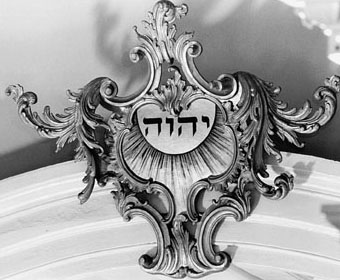
What's more fascinating to me is that the Tetragrammaton, the Four Letters, the Hashem, the Name, "YHWH", is part of the decor of this place. Here are two links to two different pictures (I'm not posting them as I don't have the rights to them, thus I'm merely linking to them).

In this first link, note the two tablets containing the Ten Commandments near the center of the picture, at the bottom of the center pane of the window; straight up from that, at the top of the window's outer arch, is the decoration containing the Tetragrammaton. If you let your browser show the image at full-size, you can actually see a blurry image of the Tetragrammaton.

http://www.feastofmusic.com/.a/6a00d8341c4fb353ef0128766aa466970c-pi

And here is a black-and-white close-up of that decoration:
http://www.nyc-architecture.com/LM/065D.jpg

(from http://www.nyc-architecture.com/LM/LM065.htm)

Monday, October 18, 2010

Sunday-Go-To-Meetin' Clothing

On one of my email lists, someone asked a question about what type of clothing we should wear when we attend church. Should it be our best, as some argue, or whatever we are comfortable in, as others would argue? The response below, by Glenn, is much heavier on scripture quotations than most responses, and I found it interesting enough to reprint here (with Glenn's permission).

What does the scripture say?

Ps 35:13 - But as for me, when they were sick, my clothing was sackcloth; I humbled my soul with fasting, And my prayer kept returning to my bosom.

Sackcloth, which most of us have probably never worn, is clothing appropriate to mourning. Sackcloth is like canvas. Most Americans wear silk or fine linen suits and dresses to funerals. We seem to have this one backwards, if God's word means anything to us.

Ps 45:13 - The King's daughter is all glorious within; Her clothing is interwoven with gold.

Fine clothing, what we would call dress-up clothing like suits and flowing dresses, are for royalty who are in the halls of the King. We are a royal priesthood, but priests wore simple linen, nothing fancy. And it was everyday clothing for them.

Ps 69:11 - When I made sackcloth my clothing, I became a byword to them.

Read this Psalm. It was haughtiness that made the psalmist a byword when he wore sackcloth. It was not because his clothing was simple or rough or un-dressy.


Pr 27:26 - The lambs will be for your clothing, And the goats will bring the price of a field,

Clothing is a gift from God to be appreciated. Making it a status symbol is accepting the world's view. We are to accept God's view instead. God does not see clothing as a status symbol...and neither should we.

Pr 31:22 - She makes coverings for herself; Her clothing is fine linen and purple.

If you can afford fine clothing, there is nothing wrong with wearing it. But there is no special standing before God because of the clothing. Even in these verses the emphasis is on the ability of the woman, not some kind of obligation to dress up.

Pr 31:25 - Strength and dignity are her clothing, And she smiles at the future.

Strength and dignity do not require a tie and suit, nor do they come as accessories. Simple clothing worn with strength and dignity makes whatever you are wearing fit for a King.

Mt 6:25 - "For this reason I say to you, do not be worried about your life, as to what you will eat or what you will drink; nor for your body, as to what you will put on. Is not life more than food, and the body more than clothing?

Jesus seemed to think that it is how you live and NOT what you wear that is important. If we begin to think differently, then we are NOT following Jesus.

Mt 6:28 - "And why are you worried about clothing? Observe how the lilies of the field grow; they do not toil nor do they spin,

Jesus put clothing in its rightful place - as a blessing from the same Creator who adorns the flowers of the field. Clothing is not something to get hung up on or worry about. Remember this - the beauty of a flower is in what the flower is. If a person IS a Christian, that is where their true beauty can be seen. If they are NOT a Christian, no finery of clothing is going to change that.

Mt 6:31 - "Do not worry then, saying, `What will we eat?' or `What will we drink?' or `What will we wear for clothing?'

If anyone needs a word direct from the mouth of Jesus on what to wear, this is it. Wear what you have on. Don't sweat what you wear. It is what is within you that makes you presentable or not. Clothing is meant as a covering for nakedness, no more and no less.

Mt 7:15 - "Beware of the false prophets, who come to you in sheep's clothing, but inwardly are ravenous wolves.

People who sweat the details of clothing miss seeing who others really are. Jesus tells us that anybody can wear any clothing, but it is who they are inside that counts. Don't be fooled by clothing that fits your idea of what looks good.

Mt 11:8 - "But what did you go out to see? A man dressed in soft clothing? Those who wear soft clothing are in kings' palaces!

Fine clothing is all well and good, but if that is how you discern the value of a person, you are not seeing things the way Jesus teaches His disciples to see things. Why is this so hard?

Lu 7:25 - "But what did you go out to see? A man dressed in soft clothing? Those who are splendidly clothed and live in luxury are found in royal palaces!

Fine clothes are for wearing to palaces. Maybe that is why folks spend so much on big assembly halls - so they can feel like they are in a palace. I would rather be near a lake, sitting on a beach with Jesus and eating the breakfast He just prepared for us (a la John 21) than sitting in a palace hoping He'll show up. If they had been in fine clothes, they could not have gone fishing and would have missed the opportunity for that intimate breakfast. And yet what they wore was totally appropriate to gather together with Jesus. Looks like fishing gear is appropriate for assemblies, eh? The important thing is they were together and they were with Jesus. The clothing is not even mentioned.

Lu 9:29 - And while He was praying, the appearance of His face became different, and His clothing became white and gleaming.

Looks like praying makes whatever you wear look amazing. Seems to me that it matters more what we are doing than what we are wearing.

Lu 12:23 - "For life is more than food, and the body more than clothing.

Does it get any more plain than this?

Joh 19:24 - So they said to one another, "Let us not tear it, but cast lots for it, to decide whose it shall be"; this was to fulfill the Scripture: "THEY DIVIDED MY OUTER GARMENTS AMONG THEM, AND FOR MY CLOTHING THEY CAST LOTS."

Looks like the only necessary consideration, even to these unbelieving Gentiles, was taking care of the clothing and not tearing it up. Reminds me of my Mom telling me not to get dirty before going to Grandma's house. We wore clothes for running and jumping and hugging Grandma, just so long as they were clean and not torn up. And I never wore a suit and tie to Grandma's house.

1Ti 2:9 - Likewise, I want women to adorn themselves with proper clothing, modestly and discreetly, not with braided hair and gold or pearls or costly garments,

Amazing, isn't it, how we seem to have forgotten all about Paul's admonition AGAINST fine clothing? In Paul's view, if it was proper, it was modest and discreet clothing, NOT finery, NOT showy, NOT exceptional, and NOT adorned with gold or pearls or costly materials.

Jas 2:15 - If a brother or sister is without clothing and in need of daily food,

The only thing to care about is NOT am I wearing my best clothing. The thing to care about is whether all the brothers and sisters have something to wear to cover their nakedness - and don't tempt them with the finery Paul admonishes us to avoid! Clothing is meant to cover nakedness modestly and discreetly.

Forget the traditions of men that have made us forget all of these words of instruction from God. Forget the world's approach to showing respect with expensive clothes. Show respect for God by making sure others have something modest and discreet to wear. Then you, too, will be clothed with strength and dignity like the worthy woman of Proverbs 31.

As the worship leader at our gathering of Christians, I often begin the call to worship with a song that you can listen to in less than five minutes at http://www.youtube.com/watch?v=NPWq8eM4lu8. We play it sometimes and we sing it together sometimes, but mostly we mean every word of it all the time.

"Come...just as you are...come...give your heart to God...come."

The world gets hung up on clothing and all kinds of other distractions. Our gathering is about Jesus - and NOT about whether your clothes are 'good enough'. He wants your heart, He who wore a simple linen garment to cover Himself modestly and discreetly. He who wore those dusty, dirty, everyday sandals that He had just come in off a long road trip wearing through dust and mud and up hillsides and into homes to heal the sick and leave a blessing. He wants your heart, not your Guccis. Come as you are and know the peace of a shared burden and the rest of knowing you never have to walk alone again.

Blessings,

Glenn, who is wearing a fine purple Tshirt and fuzzy black stretch pants and tennis shoes as he shares what the Spirit is saying to all who will listen ...

Thursday, September 23, 2010

(Don't) Follow the Leader

The nation of Israel was in its glory days about 1000 B.C. under the kingship of David and Solomon, but one king later, the nation divided into two, a Northern set of 10 tribes (aka "Israel") and a Southern set of two (aka "Judah"). Over the next couple of centuries, the leadership of the Northern Israel was particularly neglectful of living as YHWH would have them live, which eventually resulted in God using the nation of Assyria to conquer and punish Israel. We see in the Biblical book of the Kings how the leadership of the nation leads up to this:
2 Kings 15:17ff Menahem son of Gadi became king over Israel. ... Sin for sin, he repeated the sins of Jeroboam son of Nebat, who led Israel into a life of sin.
2 Kings 15:23ff Pekahiah son of Menahem became king of Israel. ... In YHWH's eyes he lived an evil life. He stuck to the old sin tracks of Jeroboam son of Nebat, who led Israel into a life of sin.
2 Kings 15:27ff Pekah son of Remaliah became king of Israel in Samaria. ... In YHWH's view he lived an evil life; he didn't deviate so much as a hair's breadth from the path laid down by Jeroboam son of Nebat, who led Israel into a life of sin.
We see that King Jeroboam led Israel into a life of sin, and these three kings followed in his footsteps. After Israel is taken into captivity, this is what God says:
MSG 2 Kings 17:7-8 The exile came about because of sin: The children of Israel sinned against YHWH, their God, who had delivered them from Egypt and the brutal oppression of Pharaoh king of Egypt. They took up with other gods, fell in with the ways of life of the pagan nations YHWH had chased off, and went along with whatever their kings did.
What I find significant here is the suggestion that if the people had not gone along with their leadership, they would not have been sent into exile from their homeland. What does this say about following our governmental leadership? I'm just askin'....

Friday, August 27, 2010

The Gates of Hell Shall Not Win

In Judges 16:1-3, we read of how the enemies of Samson thought they had him trapped in a city, planning to kill him at daylight, but Samson just tore out the gates of the city during the night and made his escape, carrying the gates with him to the top of a local mountain.

Hold that thought.

Several hundred years later, Yahshua is at the city of Caesarea Philippi with his young disciples, who were probably embarrassed to be at such an ungodly center of smut, wondering what in the world their rabbi was thinking to bring them here. This city was to Pan-worship as the Vatican is to Roman Catholicism. It was the capital city, the center, of cult worship to the goat-god Pan.

Just outside the city, and perhaps where Yahshua was standing, was a stone slab at the entrance to a cave. From this cave flowed the headwaters of the Jordan River. (In the 19th century, an earthquake shifted the river so it no longer flows from the cave).

Pan (from who's name we get the word "pandemonium") was a fertility god who every Autumn went into this cave which served as the gateway to the underworld, where he would spend the Winter. When Springtime arrived, Pan emerged from this gateway of hell to consort with his wife, Ashtarte ("Easter"), and in copulating with her, his sperm fell to the earth as rain, making the land fertile. His followers worshiped this goat-god on this stone slab in an annual fertility orgy involving all sorts of deviations, including human-goat sex.

Hold that thought.

The word "church" seems to have its origins in one of two sources. One is the Greek word "kuriokon" ("house of the lord" - never used in the N.T., although the root, "kuriokos" - "of the lord" - is used twice: the Supper of the Lord in 1 Cor 11:20, and the Day of the Lord in Rev 1:10). The other source is the even-older Celtic dialects that eventually gave us "kirk" ("church") and "circle". In many ancient pagan religions, particularly in Europe, the gathering places were in a circular form (think Stonehenge).

In either case, both words refer to a place, not to people, but the word used in the New Testament, "ekklesia" ("called out", "assembly", "congregation"), refers to people, not a place.

When the Bible was translated into English in the 13-16th centuries, the European idea of a pagan church/circle meeting place became confused with the Biblical idea of an assembly, and our English Bibles inherited the non-Biblical term "church".

That means that when we read Matthew 16:18 in most of our English Bibles, we get a concept of a place or thing which Yahshua intended to build, rather than a congregation.

Hold that thought.


Or better yet, put all three of these thoughts together.

Yahshua is standing with his disciples near, perhaps even on, the stone slab of a pagan, hellish religion, just outside the "gate" to the realm of evil in which humanity is destined to be trapped without a savior. He's speaking to a group of kids who were well-familiar with the story of Samson, who had broken through the gates of the city, in which he would be destined to death if he had not escaped.

In this context, Yahshua stands on or near this stone slab and makes an announcement to Peter that these gates of hell will not prevent his people from being called out of their death-trap, nor prevent his people from going into the depths of hell and defeating the evil therein.

Here's what he says:
On this stone slab, I will edify the people I call out; and the gates of hell will not be strong enough to withstand their attack.

Monday, August 23, 2010

Mmm, Watermelon Juice in the Lord's Supper....

All my life, my religious culture has insisted that we rely on the Bible as our only infallible source for how to live Godly lives. 2 Timothy 3:16-17 is an example of the textual support for this idea:
16 All Scripture is inspired by God and is profitable for teaching, for rebuking, for correcting, for training in righteousness, 17 so that the man of God may be complete, equipped for every good work.
Whereas this sounds good in theory, I've recently been made more and more aware that we don't do a very good job of living up to this ideal.

For example, from where do we get the idea that we're supposed to use grape juice as the drink in the Lord's Supper?

Looking throughout the Bible for hints concerning the drink used at the Passover (which is the context for the establishment of the Lord's Supper), there's no clue offered until the Gospel accounts, at which time the only clue found is that it is "the fruit of the vine".

With only this information (and that it represents the blood of Christ, given in sacrifice), doesn't it make sense that tomato juice (blood-like, from the vine) would be the best option for the drink at the Lord's Supper?

Or if you just want a fruit of the vine, and don't care about the color, we could use cantaloupe juice, or watermelon juice, or blueberry juice, or passionfruit juice, or any number of other vine fruit juices.

But we don't; we use grape juice (either fermented or not).

The point is: We use grape juice, not because it's taught in the Bible, but because it's a tradition we have inherited from some source outside of the Bible. I think extraBiblical history makes a strong case for using grape juice. But I'm just pointing out that going to extraBiblical history is not relying solely on the the Bible.

"So what," you ask?

If someone wants to use watermelon juice in the Lord's Supper, we can make no objection if we really use the Bible as our sole source of authority in such matters. To make a law that the juice must be grape juice is to teach as doctrine the commandment of men.

We do this a lot. We need to be careful.

Thursday, August 05, 2010

Taking Text out of Context

It's easy to do. We get an idea in our head, search the Bible concordance to find references that might apply, and voila! There's the magic verse that proves our case!

Except, a lot of the time, we've taken the verse out of context, making it say something that it does not say, putting meaning into the text that God did not put there, instead of getting meaning out of the text.

For example, many of my brethren are convinced that drinking any alcohol is a sin (no matter that alcohol consumption is never directly condemned in the Bible, Yahshua declared all foods clean, and Paul stated that "everything is permissible" but not necessarily "good"). (The Bible does, however, condemn drunkeness, and it makes clear that alcohol is dangerous and the wise person will leave it alone.)

As support of their position, they will sometimes point to Habakkuk 2:15:
15 “ Woe to him who gives drink to his neighbor,
Pressing him to your bottle,
Even to make him drunk,
That's pretty slam-dunk, I'd say. Based on this one verse alone, it's clear that Yahshua would not turn water into alcoholic wine at the marriage feast of his neighbors.

Except, the verse is taken out of context. Let's finish the verse with its last line:
That you may look on his nakedness!
Wow! Okay, that changes the entire tone of the passage. It's not about giving alcohol to your neighbor; it's about trying to get your neighbor drunk so that you can take advantage of him.

And when we look at the rest of the chapter, we see this latter interpretation meshes well with the surrounding context.

Starting at verse 4, the condemnation is against he who is proud, whose soul is not upright in him.

Then in verse 5 he gets bravery from a bottle, gets proud and cocky, and goes and attacks those around him, trying to become world dictator.

In verse 6, those he attacks complain that he's taking what is not his.

Verse 8 speaks of his violence and plundering.

Verses 9-10 mention how he cheats to get ahead.

Verse 12 condemns him who uses evil and bloodshed to build an empire.

In verse 15 is our passage under consideration: woe to him who gets his neighbor drunk so that he can take advantage of that neighbor.

In verses 16 and 17 God warns that He will turn the tables on the perpetrator in verse 15, making the perp drunk so that he will then be exposed, making the violence that he has done come back on him.

I'm in agreement that alcohol consumption should be avoided; I believe it's stupid. (I also believe soft-drink consumption (and Twinkie-consumption, etc) should be avoided; I believe it's stupid also; just not so car-crashing immediately stupid). But Habakkuk 2:15 is not a condemnation of social drinking; it's a condemnation of using and abusing others.

Tuesday, July 20, 2010

Euthanasia

In the last chapter of 1 Samuel, we find King Saul surrounded by his enemies, and rather than risk being captured and tortured, he asks his assistant to run him through with a sword. The assistant refuses, so King Saul falls on his own sword.

In the next chapter, the first chapter of 2 Samuel, we find that a third party, an Amalekite, claims to the future King David to have come upon King Saul, who was not yet dead but beyond recovery. He further claimed that at Saul's request, he finished the dying king off.

David soon thereafter had this Amalekite executed. Staying in context, the reason for the execution is that the Amalekite lifted his hand against one who had been anointed by God. But if we take a little bit of liberty with the text, it's not hard to apply this to the idea of euthanasia, mercy-killing, in general.

It may be "merciful" to put a terminal patient out of his misery; after all, he's going to die anyway; why make him suffer any longer than necessary? But in Saul's case, the "mercy-killing" of an almost dead man was considered worse than letting that almost-dead man die on God's time-frame.

Don't think I'm offering any answers, or even any wisdom, here. I'm just reporting the story, and wondering how, if at all, it might apply to our modern tendency to pull the plug on hopeless cases.

Monday, June 28, 2010

If You Love Me, You Will Keep My Commands

In my previous post, I spoke of rules and regulations in both the Old Testament and the New Testament. As I wrote it, it struck me that in the Old Testament, there are many specific commands given for God's people to follow. In the New Testament, there really aren't that many. Yes, there are a few, but not nearly as many as most of us think there is.

Instead, we've used our logic and common sense and have taken this verse and jigsaw-puzzled it together with that verse to come to a conclusion that we then label as a "command of Jesus". But if we're to be absolutely honest, those are not commands given by Jesus, but rather commandments of men that we make into doctrines.

Don't believe me? Give it a try. Give me the book/chapter/verse containing a command (not a logic-derived conclusion) for each of the doctrines below:

- no hand-raising in worship

- must attend church every time the elders have established for regular meetings

- there must be a multiplicity of elders in each local congregation

- singing in worship must be a cappella

- the main purpose of assembling is to worship God

- you must not drink alcohol or you sin

- you must give money to the church every Sunday

- you must take the Lord's Supper every Sunday

- you must attend church on Sunday

- you must add "in Jesus' name" to every prayer (preferably at the end)

- you must dress up for Sunday church

- you must have a sermon during church

- you must not applaud/clap during church

- you must bow your head and close your eyes during prayers

- you must use Elizabethan English in your songs and prayers

- you must limit "worship" to the specified times of worship

- you must not do anything beyond the "five acts of worship" during worship

- the fruit of the vine in the Lord's Supper can only be grape juice

Please don't think I'm trying to change any of these things (okay, a few of them I'd do away with - the Elizabethan English I think does harm). I'm just pointing out that much of what passes as "commands" in our thinking are not commands. They may be correct conclusions (since the Fall, our logic is not to be trusted completely), but logic-derived conclusions are not commands.

Careful; it might shake up your paradigm if you think about this too much. Keep the commands of Jesus, yes, but don't make the mistake of believing a non-command is a command.

Rules & Regulations

Most Christians recognize the two main dispensations (time periods) recorded in the Bible: the Mosaic dispensation when the Law of Moses reigned over God's people (most of the "Old Testament"), and the Christian dispensation when the Law of Christ reigns over God's people (the "New Testament").

There were specific commands that were required in the Law Of Moses, such as:

- males must be circumcised
- Sabbath days were to be kept
- certain holy days were to be observed
- sacrifices (often animal) were to be made

But Christians recognize that Paul claimed that the rules and regulations of the Law of Moses no longer apply, because what God truly wants is righteousness coming from a good heart, not from ticking the boxes on a checklist:
HCSB Gal 5:14 For the entire law is fulfilled in one statement: You shall love your neighbor as yourself.
What many Christians fail to recognize is that Paul feels the same way about the rules and regulations of the "Law of Christ". Many Christians believe the "Law of Christ" to be essentially equivalent to the rules and regulations found in the New Testament, pointing to specific commands such as:

- we must be immersed
- we must not get drunk
- we must remember the Lord's death in the Lord's Supper
- we must make offerings

But the same thing Paul said about the rules and regulations of the Old Law he also says about the New Law, just a few verses later:
HCSB Gal 6:2 Carry one another's burdens; in this way you will fulfill the law of Christ.
If we really believe that specific commands in the Old Law, even the "supreme, absolutely must be done without fail" command of circumcision, are "nothing":
6 For in Christ Jesus neither circumcision nor uncircumcision accomplishes anything; what matters is faith working through love.
then to be consistent we must also recognize that "supreme, absolutely must be done without fail" commands in the New Law are also "nothing" in comparison with "faith working through love", i.e., "carrying one another's burdens".

Yes, yes, I know: the black-and-white of the New Law text says "you must do X". But the black-and-white of the Old Law text also said "you must do X". But Paul says the Old Law command is fulfilled in loving your neighbor; he also says that the New Law command is fulfilled in loving your neighbor (by bearing his load).

If it's true for the Old because Paul said it; it's also true for the New because Paul said it.

The same arguments we use to support our pet doctrine were also used by the Pharisees in the early years of the church, who insisted that "the Book" required circumcision. And they were right: the Book did require circumcision (even before the temporary Law of Moses, so that even if the Law of Moses itself is gone, the command to be circumcised is not). But Paul said what mattered was faith working in love, not keeping the technical details of the written code.

We today are focused on keeping the technical details of the written code. The written code is good (as Paul says of the Old written code), but that's not what matters. He writes:
HCSB Col 2:20 If you died with Christ to the elemental forces of this world, why do you live as if you still belonged to the world? Why do you submit to regulations: 21 "Don't handle, don't taste, don't touch"? 22 All these [regulations] refer to what is destroyed by being used up; they are human commands and doctrines. 23 Although these have a reputation of wisdom by promoting ascetic practices, humility, and severe treatment of the body, they are not of any value against fleshly indulgence.
We moderns try to interpret this passage as a condemnation of Old Testament regulations, but that's because we're reading meaning into the passage rather than taking meaning out of the passage. What does the passage say? It says that submitting to regulations (not to "Mosaic Law regulations") is living as if you belong to the world.

He expands on this idea a few verses before:
16 Therefore don't let anyone judge you in regard to food and drink or in the matter of a festival or a new moon or a sabbath day. 17 These are a shadow of what was to come; the substance is the Messiah. 18 Let no one disqualify you, insisting on ascetic practices and the worship of angels, claiming access to a visionary realm and inflated without cause by his fleshly mind.
He addresses it elsewhere as well, again saying that what matters is how it affects other people:
HCSB 1 Cor 10:23 "Everything is permissible," but not everything is helpful. "Everything is permissible," but not everything builds up. 24 No one should seek his own [good], but [the good] of the other person.
So whereas rules such as "You must never drink alcohol" or "You must go to church three times a week", etc, sound good, that's not what Christianity is about.

Christianity is about others. According to the scriptures, the Law of Christ is fulfilled in this one command: Bear one another's burdens.

Monday, June 21, 2010

A Secular Society

In the early days of the German advance into Eastern Europe, before the possibility of Soviet retribution even entered their untroubled imagination, Nazi extermination squads would sweep into villages, and after forcing the villagers to dig their own graves, murder their victims with machine guns. On one such occasion somewhere in eastern Europe , an SS officer watched languidly, his machine gun cradled, as an elderly and bearded Hasidic Jew laboriously dug what he knew to be his grave.

Standing up straight, he addressed his executioner. “God is watching what you are doing,” he said.

And then he was shot dead.

What Hitler did not believe and what Stalin did not believe and what Mao did not believe and what the SS did not believe and what the Gestapo did not believe and what the NKVD did not believe and what the commissars, functionaries, swaggering executioners, Nazi doctors, Communist Party theoreticians, intellectuals,Brown shirts, Black shirts,gauleiters, and a thousand party hacks did not believe was that God was watching what they were doing.

And as far as we can tell, very few of those carrying out the horrors of the twentieth century worried overmuch that God was watching what they were doing either.

That is, after all, the meaning of a secular society.
(taken from David Berlinski’s book ‘The Devils delusion Atheism and its scientific pretensions’) as quoted at http://telicthoughts.com/berlinskis-wisdom/

Wednesday, June 09, 2010

Temple Police

Barbara Brown Taylor writes an interesting article in which she points out:
One of the many things [the Good Friday crucifixion of Jesus] story tells us is that Jesus was not brought down by atheism and anarchy. He was brought down by law and order allied with religion, which is always a deadly mix. Beware of those who claim to know the mind of God and who are prepared to use force, if necessary, to make others conform. Beware of those who cannot tell God’s will from their own. Temple police are always a bad sign.
Then, after pointing out that Judas had been Jesus' friend, she tells this story:
I remember being at a retreat once where the leader asked us to think of someone who represented Christ in our lives. When it came time to share our answers, one woman stood up and said, "I had to think hard about that one. I kept thinking, ‘Who is it who told me the truth about myself so clearly that I wanted to kill him for it?"’
I find these two thoughts worth pondering.

Tuesday, June 08, 2010

Who Are You Tuning Out?

In the Biblical book of Exodus we read the story of how the young Israelite nation has been enslaved by the Egyptian Pharaoh, in whose land they were temporarily living. YHWH God raises up a man, Moses, whose job it is to lead them out of Egyptian slavery back into their promised homeland. Because Moses had a speech problem, YHWH appointed his older brother, Aaron, as his mouthpiece.

YHWH tells Moses:
HCSB Exodus 7:1 See, I have made you like God to Pharaoh, and Aaron your brother will be your prophet. 2 You must say whatever I command you; then Aaron your brother must declare it to Pharaoh so that he will let the Israelites go from his land. 3 But ... Pharaoh will not listen to you....
This parallel strikes me:

God --> prophet --> hearers
Moses --> prophet --> hearers

What struck me about this is God's use of a human to communicate; God did not speak directly to Pharaoh; nor did He use his prophet to speak to Pharaoh; rather, He used his prophet's prophet to speak to Pharaoh.

As far as Pharaoh was concerned, he was hearing a human's mind, and Pharaoh's response was to reject what he heard.

This raises a question in my mind: When I reject another human's words to me, am I rejecting a message God intended for me?

I'm not saying that God is going around telling Bob to tell Mary X & Y. I'm just asking if perhaps Mary is tuning out God's message when she tunes out Bob.

Who are you tuning out? Or perhaps the only question I can really ask is, Who am I tuning out?

Tuesday, June 01, 2010

What The Gospel Is

In my last post, I discussed what the Gospel is not, specifically, that it is not equivalent to the New Testament. Here I want to explore what the Gospel is.

There are at least two definitions of "the Gospel" in the New Testament. The first is given in 1 Corinthians 15:
HCSB 1 Cor 15:1 Now brothers, I want to clarify for you the gospel I proclaimed to you; you received it and have taken your stand on it. 2 You are also saved by it, if you hold to the message I proclaimed to you—unless you believed to no purpose. 3 For I passed on to you as most important what I also received:
that Christ died for our sins according to the Scriptures,
4 that He was buried,
that He was raised on the third day according to the Scriptures,
5 and that He appeared to Cephas, then to the Twelve.
6 Then He appeared to over 500 brothers at one time,
most of whom remain to the present, but some have fallen asleep.
7 Then He appeared to James, then to all the apostles.
8 Last of all, as to one abnormally born, He also appeared to me.
So, according to this first definition, the Gospel is the death, burial, resurrection, and appearance of Christ.

However, according to at least three other sources, the Gospel is that all nations will be blessed.

Highlights of Romans 10:14 - 12:1

Not all have obeyed the gospel; didn't they hear? Yes. Didn't Israel understand when Moses announced that they would be made jealous by the salvation of non-Jews, and when Isaiah said that God would be found by those not looking for Him, while the Jews, to whom God was spreading out His hands, remained disobedient and defiant? Yet God's mercy extends to both Jew and Gentile, to the Gentile who has been grafted into God's olive tree by faith, and to the Jew who can be re-grafted back into the tree if he'll stop abiding in unbelief. Regarding the gospel, the falling away of the Jews results in the salvation of Gentiles. Both groups have disobeyed, and God has imprisoned all in disobedience, so that He may have mercy on all. Therefore, worship God by presenting your bodies as a living sacrifice.

So we see in this summary that the gospel is that not just the Jews, who were chosen, but also the Gentiles, will be blessed with God's mercy.

Highlights of Galatians 2:11-16

Paul had to correct Peter publicly, because he was deviating from the truth of the gospel. Peter should have remembered that just as the Jews had been justified by faith, so too the Gentiles, so he should quit acting like the Gentiles were not part of the family.

So we see in this summary that deviating from the gospel is to forget that not just the Jews, who were chosen, but also the Gentiles, were blessed with God's mercy.

Highlights of Galatians 3:8
The Scripture foresaw that God would justify the Gentiles by faith and foretold this gospel to Abraham, saying, "All the nations will be blessed in you."

So we see in this summary that the gospel is that not just the Jews, who were chosen, but also the Gentiles, will be blessed.

So, in summation, there are at least two Biblical definitions in the New Testament for the term "Gospel" (or "Good News"):

1) the death, burial, resurrection, and appearance of Christ

and

2) that not only the chosen Jews, but also the Gentiles, would be blessed with salvation by faith in Christ.

What the Gospel Is Not

Norman R. writes the following:

What is the gospel?
2 Thess 1:7-9 He will punish those who do not know God and do not obey the gospel of our Lord Jesus. 9 They will be punished with everlasting destruction and shut out from the presence of the Lord and from the majesty of his power.
What I taught and what is still taught by many congregations is that the word gospel in this verse includes everything in the NT.

All the Christians on the day of Pentecost obeyed the gospel before any of the New Testament was written and all the Christians who died at the orders of Saul died before any of the New Testament was written.

In about 58 a.d. Paul wrote Galatians, the second book of the New Testament to be written. All the Galatians had obeyed the gospel and some wanted to leave it, before they read Galatians, and probably before they read any book of the New Testament. Galatians may be part of the gospel to some Christians, but it certainly was not part of the gospel to the Galatians.

The NT Christians did not need Galatians, Romans, Acts, Matthew or other letters to be in fellowship with God. Faith in the death, burial, resurrection, ascension and the promises through that sacrifice placed them in fellowship with God.

Why were the epistles of Paul, Galatians, Romans, Corinthians, etc. written? It appears that some of the churches wrote to Paul with questions. They wanted answers to some of the things they didn't understand. Paul heard that some churches were having problems and Paul wrote these churches to correct some problems. Have you ever noticed that we would have a very small New Testament if the church had been perfect? Most of the New Testament was written to correct some problem in the church. Some do apply to us and some don't apply, but we have a multitude of principles that we can use.

In other words, "the Gospel" does not equate to "the New Testament".

Some might respond that the early Christians had all the information provided by the New Testament via supernatural revelation, even if it had not yet been written down. But in at least the question of whether Gentile Christians had to submit to the Jewish Law (Acts 15), there were Gentile Christians who had obeyed "the Gospel" prior to this matter being settled. Thus, in this issue at least, the New Testament contains information which those Gentile (or Jewish) Christians could not have known even though they had obeyed "the Gospel".

Simply put, once again, "the Gospel" is not the same as "the New Testament".