Tuesday, February 03, 2015

Acts 20

 ESV Acts 20:7 On the first day of the week, when we were gathered together to break bread, Paul talked with them, intending to depart on the next day, and he prolonged his speech until midnight.

As you may recall, there was a "Second Passover", a month after the first, for those who could not, for reason of being ceremonially unclean (e.g. for having touched a corpse, etc), participate in the first one. You can read about this in Numbers 9:1-14.

Although the timing is somewhat off, the Acts 20:7 event could conceivably be this second Passover.

Luke and his contingent sailed from Philippi after the days of Unleavened Bread (Acts 20:6). So they sailed at least one week after the first Passover. It took 5 days to reach Troas; that's almost a second week. Then they spent seven days at Troas. That's a third week.

If Luke and his company waited an extra 10 days after the Feast of Unleavened Bread before setting sail, instead of leaving immediately after (maybe they wanted to visit another week, or they were having trouble getting on a ship, with all the hordes from the Feast week vying for tickets), that puts the Acts 20:7 meal right on the mark for the second Passover.

Granted, this is just speculation, but it's worth putting on the table for consideration.

Another thing about Acts 20:7, there's no indication whatsoever that they had not been meeting every day that week. There's no indication that they were, but there's no indication that they weren't. It would be more consistent with Paul's standard method of operating to meet daily with the locals. Otherwise the group has just wasted a week (even more for Paul, who had already been there a while - v. 5) waiting seven days for meeting-time.

Likewise, there's no indication that they had not been eating supper together every night that week. After all, people do eat pretty much every day.

If we were writing a brief account of one of our travels, we might write something like, "So we left Hickstown after the Parade Day, was on the road for five days, and got to Dingleville, where we stayed seven days, having a gospel meeting. The first day of the next week, when we had gathered for supper, expecting to leave the next morning, an amazing thing happened. Let me tell you about it."

There's no reason to conclude from this reading that the "gathering for supper" is anything special, or that it hadn't been done every night of the week.

Or, maybe it was a special supper, but not the Lord's Supper; maybe it was a going away supper for the visiting missionaries. Don't we do that sort of thing in our time?

Or maybe the local synagogue always met for supper after the close of the Sabbath assemblies; don't some of us often do that in our churches in our time?

I'm more inclined to think that Paul's crew had been meeting with the locals all week, and when the Sabbath rolled around, they met again in the synagogue, as was Paul's custom, and at the close of the Sabbath, after sundown marked the start of the first day of the week, everyone left the synagogue and met in their "fellowship hall" for a pot luck, just like we often do after Sunday morning assemblies. While the women were preparing the food (they wouldn't have prepared it on the Sabbath itself, both because of their cultural conditioning and so they wouldn't be offensive to the not-yet-converted Jews in their realm of influence), the men talked a long time (the women listening as best they could while cooking), and one of the young men fell asleep and fell out the window. After the excitement of that event, they all went back inside to the dining hall, where the women served the meal, and then the women cleaned up, later joining the men who were in deep discussion until daybreak. And if the Lord's Supper was conducted as a part of this meal (as Jesus had done in the original Lord's Supper, and as the Corinthians had been doing, but selfishly in that they were looking just to feed their own faces, and as probably referenced in Jude 1:12 as a "Love Feast", and as probably intimated in 2 Peter 2:13), it's probably the women who served the Lord's Supper to the congregation, unlike our modern practice where we exclude the women from being servers, because somehow we equate serving with leading or teaching or wresting authority from the men.

And if any of the travelers were meticulous about keeping the Law (which we know Paul was - v. 24 of the very next chapter), they would not be traveling on the Sabbath, which would add another reason for waiting until the first day of the week before having a final meal with everyone.

That's not even touching the meaning of "mia ton sabbaton" as idiomatically meaning "first day of the week" as opposed to the literal meaning of "first [or one] of the sabbaths". People a lot smarter in Greek than I am come down on both sides of the issue (even though most of the standard consensus writers claim it's an idiom meaning "first of the week").

In other words, there are a lot of gray, unanswered questions about this text, and for us to be dogmatic about any one of them is, in my estimation, unwise.

Originally published at:
http://kentwest.blogspot.com/2015/02/acts-20.html

Wednesday, January 28, 2015

The Assembly is for Believers, Not Unbelievers

Read 1 Cor 14 with a fresh mindset, committed to reading it with an open mind, in order to understand the following.

1 Cor 14 indicates that the assembly is designed to benefit the believers, not the unbelievers. Unbelievers will benefit if they come,
but that's not the focus. So offering an invitation makes no sense.

We were tasked with going into all the world and making disciples, not with inviting them into our meetings designed for believers in order to try to convert them there.

Our assemblies are not for the purpose of worshiping God (vertical focus), or for pulling in outsiders to convert them, but for encouraging one another (horizontal focus). These other activities (worship and conversion) will take place in our assemblies, but they're not the purpose for our assemblies.

A special "Gospel Meeting" would be an appropriate time to reach out to unbelievers, but only if it was designed to appeal to unbelievers, rather than simply an extended version of our current meetings.

(While on the subject, notice that according to 1 Cor 14, our current meetings have the wrong focus (vertical instead of horizontal) and are organized in opposition to Paul's instructions, wherein each member uses whatever God-given gift he has in order to encourage others, one by one, so that all may encourage and all may be encouraged. This is reiterated by Peter, in 1 Peter 4:9-11: "Offer hospitality to one another without grumbling. Each one should use whatever gift he has received to serve others, faithfully administering God's grace in its various forms. If anyone speaks, he should do it as one speaking the very words of God. If anyone serves, he should do it with the strength God provides, so that in all things God may be praised through Jesus Christ.")
 

"Church" should be for the benefit of believers, not unbelievers, and if you're going to have an outreach program such as a "Gospel Meeting", it needs to be designed for the benefit of unbelievers, not believers.

Note that there's nothing wrong with evangelizing non-Christians within our assemblies; in fact, it's a good thing. What I'm railing against is that the Biblically-stated purpose of assembling is to build up the converted, and it seems to me that we've neglected that stated purpose for other things, such as worshiping (also a good thing in our assemblies (1 Cor 14:17, 25), but not the stated purpose for them (1 Cor 14:17, 26)) and converting. Both of these are good things, but not at the neglect of the God-stated purpose, that of the building up our own.

When you invite a non-believer to the assembly in hopes of the preacher converting him, you're in essence expecting the purpose of the assembly to be the conversion of unbelievers. It's great that an unbeliever might be converted (as happens late in chapter 14 of 1 Corinthians, not as the result of preaching, however, but of being convicted and judged by all the members, not just the preacher, thus revealing his inner secrets), but to expect that is to expect something that is not the purpose of the assembly.

All I'm saying is that we need to realign our thinking of the assembly to be more Biblical. The assembly is for believers, not for unbelievers.


Originally published at:
http://kentwest.blogspot.com/2015/01/the-assembly-is-for-believers-not.html

Tuesday, January 27, 2015

Allah is God?!

Allah is the generic Aramaic word for "God", like the Hebrew Elah (or more commonly recognized in another form, El).

The Scriptures teach us that all of humanity, believers and pagans alike, know of God, testifying that...
what may be known of God is manifest in them, for God has shown it to them. (Rom 1:19).
Paul recognizes that the pagans in Athens worship the one true God, although in ignorance:
Therefore, the One whom you worship without knowing, Him I proclaim to you. (Acts 17:23).
Muslims themselves declare that when they use their language's term for "God", that being Allah, they mean the God of Abraham, Isaac, and Jacob.

Do we accuse the French of worshiping a different God because they use the French word for God, Dieu?

Why is it that the Scriptures declare that the world can know of and even worship God (albeit in ignorance), without even knowing His name at all, but we can't admit the possibility that Muslims worship this same God in ignorance, using a different language?

Note, I'm not suggesting the Muslims worship God correctly. I'm merely suggesting that they, like us, are seeking God. Paul says this is by God's design, that God...
has made from one blood every nation of men to dwell on all the face of the earth, and has determined their preappointed times and the boundaries of their dwellings, so that they should seek the Lord, in the hope that they might grope for Him and find Him. (Acts 17:26ff).
Even Muslims are designed by God to grope for Him, in hope of finding Him.

Apollos knew some things about the Lord, but he needed Priscilla and Aquilla to take him aside and explain to him more accurately the way of God (Acts 18:24ff). Muslims also need to have the way of God explained more accurately to them. They recognize that the One, True God exists, and they're willing to worship Him. We should take them aside and explain to them more accurately the way of God, not cast them away as unworthy of seeking Him.

Originally published at:
http://kentwest.blogspot.com/2015/01/allah-is-god.html

Friday, January 09, 2015

"Old Testament"?

What we, and our Bible publishers, call "Old Testament", is not what the Scriptures call "old testament".

Originally published at:
http://kentwest.blogspot.com/2015/01/old-testament.html

Thursday, January 01, 2015

Church Giving

Most modern Christians are under the impression that church members should give at least ten percent (a "tithe") of their income to the local church treasury.

But is this the Biblical model? (No, but there's nothing wrong with it, as long as it's not coercive.)

We tend to think that the Jews were required to give a tithe of their income to the Lord, and that we should do at least that well. Even among those of us who believe the "legal" requirement of a tithe is no longer binding, it's commonly believed that a tenth should be the starting point for giving.

The Jewish Background
--
The Jews were required to leave the corners of their crop fields unharvested. These unharvested corners could then be reaped by the poor of the community. (Note that the poor still had to work to feed themselves.) This corner-harvesting is what we see the widow Ruth doing, to feed herself and her mother-in-law, in the book of Ruth. This corner "tax" probably amounted to 1-3% of the farmer's income. Note that this "tax" was not levied against the poor, who benefited from this "tax", nor was it levied against non-farm industries.

The Jews were required to take a tenth (the "tithe") of their income to the national "church", the Temple, at feast-time. This was often in the form of a sacrificial animal and/or first-fruits of their crops. The priests working at the Temple would then cook/prepare this food, and take a portion of that food for themselves, and the remaining portion would then be eaten by the donor and his family as part of the feast.

Every third year, an additional tithe (averaged over three years would be about 3%/year) would be given to the priests. Here's the relevant passage from Deuteronomy 14:
22 “Each year you are to set aside a tenth of all the produce grown in your fields. 23 You are to eat a tenth of your grain, new wine, and oil, and the firstborn of your herd and flock, in the presence of Yahweh your God at the place where He chooses to have His name dwell, so that you will always learn to fear the Lord your God. 24 But if the distance is too great for you to carry it, since the place where Yahweh your God chooses to put His name is too far away from you and since the Lord your God has blessed you, 25 then exchange it for money, take the money in your hand, and go to the place the Lord your God chooses. 26 You may spend the money on anything you want: cattle, sheep, wine, beer, or anything you desire. You are to feast there in the presence of the Lord your God and rejoice with your family. 27 Do not neglect the Levite within your gates, since he has no portion or inheritance among you.
28 “At the end of every three years, bring a tenth of all your produce for that year and store it within your gates. 29 Then the Levite, who has no portion or inheritance among you, the foreigner, the fatherless, and the widow within your gates may come, eat, and be satisfied. And the Lord your God will bless you in all the work of your hands that you do.
So the total Jewish "tax" on a Jewish family was about 16% (tithe, plus third-year tithe (3%), plus field corners (3%)).

The typical federal tax on an American family is closer to about 30%, not including sales taxes and state taxes and gasoline taxes and utility taxes and administrative fees, etc. Add another 10% for a church "tithe" to that, and it's no wonder many American Christians feel less than cheerful about giving to support a system that seemingly does little more than buy bigger church buildings and fancier ties for the preacher. Even in the little struggling churches, a member must often choose between paying his own electric bill or that of the church building.

The First Century Church
--
When the church first began, it was exclusively Jewish. As such, these Jewish Christians were still giving their tithes to the Jewish system. But in addition, they were living communally:

Acts 4:32 Now the large group of those who believed were of one heart and mind, and no one said that any of his possessions was his own, but instead they held everything in common.
In addition, they also had garage sales and brought the proceeds to the church leaders to distribute to the other members of the church as they needed:
Acts 4:34 For there was not a needy person among them, because all those who owned lands or houses sold them, brought the proceeds of the things that were sold, 35 and laid them at the apostles’ feet. This was then distributed for each person’s basic needs.
Later, after Gentiles were grafted into this Jewish Christianity, it was foretold by the prophet Agabus that a famine was about to hit the entire Roman world, which led the Christians in Antioch to take up a collection to send to the saints back in Jerusalem:
Acts 11:27 In those days some prophets came down from Jerusalem to Antioch. 28 Then one of them, named Agabus, stood up and predicted by the Spirit that there would be a severe famine throughout the Roman world. This took place during the time of Claudius. 29 So each of the disciples, according to his ability, determined to send relief to the brothers who lived in Judea. 30 They did this, sending it to the elders by means of Barnabas and Saul.
Later, as Paul recounts these events, he says:
Gal 2:9 When James, Cephas, and John, recognized as pillars, acknowledged the grace that had been given to me, they gave the right hand of fellowship to me and Barnabas, agreeing that we should go to the Gentiles and they to the circumcised. 10 They asked only that we would remember the poor, which I made every effort to do.
As part of this fund-raising effort, Paul particularly appealed to the Gentile churches in the far-away regions of Macedonia, Achaia (Corinth), and Galatia (to whom Paul wrote the above quote). At the beginning of the fund-raiser, Paul writes:
1 Cor 16:2 Now about the collection for the saints: You should do the same as I instructed the Galatian churches. On the first day of the week, each of you is to set something aside and save in keeping with how he prospers, so that no collections will need to be made when I come. When I arrive, I will send with letters those you recommend to carry your gracious gift to Jerusalem.
And then a year later he writes to them again, saying that the Macedonian churches did good with their part of collecting, in part because Paul had bragged to the Macedonians about how the Achaian churches, which included the Corinthian church, were so eager to help:

2 Cor 9:1 Now concerning the ministry to the saints, it is unnecessary for me to write to you. For I know your eagerness, and I brag about you to the Macedonians: “Achaia has been prepared since last year,” and your zeal has stirred up most of them.
But now he's afraid that the Corinthians will be an embarrassment if they don't carry out on their promise:
2 Cor 9:4 For if any Macedonians come with me and find you unprepared, we, not to mention you, would be embarrassed in that situation. Therefore I considered it necessary to urge the brothers to go on ahead to you and arrange in advance the generous gift you promised, so that it will be ready as a gift and not as an extortion.
That's a large part of the reason Paul is writing 2 Corinthians, in order to get them to get busy collecting funds to send to Judea. But notice that what looks to be a command to give in 1 Cor 16:2 is not actually a command. Paul writes:
2 Cor 8:8 I am not saying this as a command. Rather, by means of the diligence of others, I am testing the genuineness of your love.
Also, note that it's a one-time fund-raiser, not an on-going forever instruction:
2 Cor 8:11 But now finish the task as well, that just as there was eagerness to desire it, so there may also be a completion from what you have.
Also note that it's not an instruction for all Christians; rather, it's an instruction for the wealthier Christians to give to the poor Christians, and that if the situation reverses, he then expects the flow of money to go the other way:
2 Cor 8:12 For if the eagerness is there, it is acceptable according to what one has, not according to what he does not have. 13 It is not that there may be relief for others and hardship for you, but it is a question of equality— 14 at the present time your surplus is available for their need, so their abundance may also become available for our need, so there may be equality. 15 As it has been written: The person who gathered much did not have too much, and the person who gathered little did not have too little.
Paul includes in this section of his letter an assurance to the Corinthians that arrangements have been made to avoid possible charges of embezzlement by him:
2 Cor 8:18 And not only that, but he was also appointed by the churches to accompany us with this gift that is being administered by us for the glory of the Lord Himself and to show our eagerness to help. 20 We are taking this precaution so no one can criticize us about this large sum administered by us. 21 For we are making provision for what is right, not only before the Lord but also before men.

When Paul arrived in Jerusalem and delivered the gift, he then was arrested by his enemies there, saying at his hearing before Governor Felix:
Acts 24:16 I always do my best to have a clear conscience toward God and men. 17 After many years, I came to bring charitable gifts and offerings to my nation, 18 and while I was doing this, some Jews from Asia found me ritually purified in the temple, without a crowd and without any uproar. 19 It is they who ought to be here before you to bring charges, if they have anything against me.
As far as regular church budget expenditures, the New Testament church had a fund for helping widows:
1 Tim 5:9 No widow should be placed on the official support list unless she is at least 60 years old, has been the wife of one husband, 10 and is well known for good works....
So far, from what we've seen in the New Testament, "giving to the church" is on an as-needed basis, from the Haves to the Have-Nots among the Saints. It's not for paying a pulpit preacher, or paying the church's electric bill, or funding Gospel missions and TV programs.

However, there is Scriptural authorization for these things also:
Gal 6:10 Therefore, as we have opportunity, we must work for the good of all, especially for those who belong to the household of faith.
1 Cor 9:7 Who ever goes to war at his own expense? Who plants a vineyard and does not eat its fruit? Or who shepherds a flock and does not drink the milk from the flock? Am I saying this from a human perspective? Doesn’t the law also say the same thing? For it is written in the law of Moses, Do not muzzle an ox while it treads out grain. Is God really concerned with oxen? 10 Or isn’t He really saying it for us? Yes, this is written for us, because he who plows ought to plow in hope, and he who threshes should do so in hope of sharing the crop. 11 If we have sown spiritual things for you, is it too much if we reap material benefits from you? 12 If others have this right to receive benefits from you, don’t we even more?
Titus 3:13 Diligently help Zenas the lawyer and Apollos on their journey, so that they will lack nothing.
Rom 16:2 So you should welcome her in the Lord in a manner worthy of the saints and assist her in whatever matter she may require your help.
Conclusion:
--
In the New Testament church, giving is not commanded, especially from the Have-Nots, but is encouraged, especially from the Haves, primarily to help financially-strapped Christians, with the goal of equality. Giving is also encouraged to help non-Christians, and to further the gospel presentation to the world and to pay the church bills.


Originally published at:
http://kentwest.blogspot.com/2015/01/church-giving.html

Wednesday, December 03, 2014

Covenants, old and new, Abrahamic and Mosaic and Christian

  • Jeremiah refers to two covenants:
    • an old one which YHWH made with the ancestors of the houses of Israel and Judah when he took them by the hand to bring them out of the land of Egypt
    • a new one which was to be different than that old one
  • Luke 1:72-73 refers to the covenant made via oath sworn to Abraham
  • Hebrews 8 specifies:
    • that the old covenant mentioned by Jeremiah is aging and about to disappear
    • that the new, better, covenant, promised in Jeremiah, is mediated by Jesus, and it delivers the promise of eternal inheritance, and a death to provide redemption of transgressions committed under the old covenant
  • Gal 3 mentions the covenant of Abraham (the same one mentioned in Luke 1), saying that it was not set aside by the coming of the temporary covenant which came 430 years later (referred to in Jeremiah as the "old covenant"), and that the old covenant was "until the Seed came". Now that Jesus has come, that old covenant is no more, and the original Abrahamic covenant is inherited by those who, like Abraham, have faith (that is, those who "belong to Christ").

Conclusions:

  • the "old covenant" refers only to the Law of Moses, and not to earlier covenants such as that with Abraham, Noah, or Adam, or to later covenants, such as that with David.
  • the "old covenant" has passed away now with the coming of Christ.
  • the "new covenant" replaces the old.
  • the "new covenant" is a continuation of the Abrahamic covenant.
  • the "new covenant" is a fulfillment of the Abrahamic promise that all nations (not just Jews) would be blessed through the Seed. In fact, this is a definition for the term "gospel" according to Gal 3:8.
  • unlike the old covenant which consisted of regulations for ministry, written in stone (Heb 9:1; 2 Cor 3:3,7), the "different" new covenant:
    • is one of the spirit of the law, not the letter of the law (2 Cor 3:6), and
    • does not consist of regulations (Col 2:20ff), but consists of "knowing God" in the heart (Jer 31:33-34).
    • Mature adults don't need "law":
      • mature adults choose to do "the right thing" regardless of written regulations
      • Jesus taught this principle, that heart-condition matters more than law-keeping:
        • in the specifics of adultery in the heart (intention) vs actual law-breaking action (Matt 5:28).
        • in his admonition to the Pharisees to administer justice and mercy and faithfulness rather then fussing over the details of tithing (Matt 23:23).
        • in his admonition to the Pharisees to "clean the inside of the cup", rather than to look shiny on the outside while being full of greed and self-indulgence on the inside (Matt 23:24-25).
      • "Law" was to get us to a state of maturity (Gal 3:24).
      • As a child, you needed a law to keep you from stepping out into the street; as an adult, you no longer need that letter of the law to keep you from getting run over, as you are mature enough now to keep the spirit of the law, which is to "be careful when crossing the street".
    • It is this heart-condition vs law-keeping-condition:
      • which justified Abraham by faith, prior to action (Rom 4:10), and
      • which God saw in Cornelius' group, leading him to cleanse their hearts prior to immersion (Acts 15:8), and
      • which allowed Jesus to define adultery, murder, greed, etc as a heart-condition rather than as an action, and
      • which makes the new covenant different from the old.
    • But with that freedom which comes with maturity comes a greater responsibility to honor the spirit of the law, and he who insults/outrages/spites the Spirit of grace will receive worse punishment than he who merely breaks the letter of the law (Heb 10:29).
Originally published at:
http://kentwest.blogspot.com/2014/12/covenants-old-and-new-abrahamic-and.html

Saturday, November 08, 2014

Jigsaw-Puzzle Theology

I was recently reading an article and came across this statement:
Only by gathering everything the New Testament says on a subject and logically fitting it all together can one arrive at the truth.
This is a perfect description of what I have in recent years called "jigsaw puzzle theology".

We're well-aware that the New Covenant is "not like" the Old (Jer 31:31), with its lists of rules clearly written in stone for all to see.

The problem is that we think the difference is that now we have *different* rules, which are not clearly listed for all to see, but are a hidden treasure, scattered throughout the last 27 books of the Bible, findable only by those who hunt hard enough, who have the right way of thinking, who have been properly trained in the nuances of distinguishing which examples are binding and which are not, which commands are binding and which were simply culture-related and not binding today, who are as smart and as sincere and as diligent as we are.

In the Old Covenant, God was clear and specific about the rules; in the New, God expects us to be jigsaw puzzle masters or to burn forever in torment.

I don't believe that's what Jesus meant when he said, "Come unto me, for my yoke is easy and my burden is light".

Originally published at:
http://kentwest.blogspot.com/2014/11/jigsaw-puzzle-theology.html

Wednesday, October 01, 2014

The Bible is Red! No, it's Blue!

What I've come to understand in the past few years is that very few things in the New Testament which are issues for us are "clear", including the necessity or not of baptism.

Imagine a prism standing in the light, viewed by two different people who know nothing of prisms. The person standing to one side would insist that "it's clear that the prism is blue!", while the person standing on the other side would insist that "it's clear that the prism is red!". Thus it is with the Bible.

It's not that the Bible "contradicts" itself; it's that it lends itself easily to opposing things depending on one's perspective. We, in our fallible human mindsets, can't abide the notion that the Bible could be true in saying both A=B and A!=B, but I think the Bible is a bit more deeper than we are, and the prism analogy applies.

- We are saved by obedience; and we are saved by faith prior to obedience. Both are true.
- Jesus is the Father YHWH; Jesus is not the Father YHWH. Both are true.
- The physical cosmos will be renewed; the physical cosmos will be consumed in fire. Both are true.
- Flesh and blood cannot inherit the kingdom of God; Enoch, Elijah, and Jesus all took their flesh into heaven. Both are true.

Until we come to this understanding, we'll always be picking one side of any particular issue and declaring as heretics the proponents of the other side.


Originally published at:
http://kentwest.blogspot.com/2014/10/the-bible-is-red-no-its-blue.html

Friday, September 26, 2014

The Meaning of "In the Name Of"

I've often heard that the phrase "in the name of" is equivalent to "by the authority of".

I would certainly agree that this is one of the meanings, but there are at least two others as well.

The second meaning is "in honor of". For example, if my grandmother dies of cancer, and I make a donation in her name to a group trying to cure cancer, that doesn't mean I've made a donation by her authority; it means I've made it in her honor. We see this type of usage in Romans 14, where Paul says if a person does X, he does X in honor of the Lord, and if he does Not-X, he does Not-X in honor of the Lord.

The third meaning is "as a representative of". If my wife sends me in her name to the PTA meeting to vote on several unspecified issues, that doesn't mean I have to call her on every issue and ask her how she wants me to vote; it means she wants me to vote as I know she would, because I know her. I believe this is the usage intended in Col 3:17 - a form of "WWJD" (What Would Jesus Do?). Act as if you're a representative of Jesus, as his ambassador; this is living in the name of Jesus.

Granted, in all of these meanings is the inherent understanding that what you're doing is in alignment with the desire of the person in whose name you're acting. So in a sense, they are all done "by the authority" of that person. But it doesn't mean you have to have specific authority for all your actions; God has given us free will and a mind and his spirit to know how to make good decisions that make him look good.

HCSB Col 3:17 [So] whatever you do, in word or in deed, do everything in the name of the Lord Jesus, giving thanks to God the Father through Him.

Originally published at:
http://kentwest.blogspot.com/2014/09/the-meaning-of-in-name-of.html

Jesus Did Not Believe in the "Nadab And Abihu" Argument for Authority In Religious Matters

Many might get riled up by the suggestion that God didn't lay down specific plans/instructions for how we are to assemble. This is a huge leap for many of us who have been trained since childhood to "keep the pattern" (a la Heb 8:5). But even within the book of Acts we can see how the "pattern" changes over time and distance, with communism being the first way of life for Christians (Acts 4:32), but moving quickly to a model allowing for private-ownership of property (Acts 5:4); with new church roles/offices being "invented" as the need arises (Acts 6:1-6); with allowances being made for different worship practices by different groups (Acts 15:6-35).

So we need to question the idea that "Everything believed and practiced in religion must have divine authority behind it."

Jesus did not believe in this principle. Please bear with me; please don't be reactive without considering what the scriptures say about it. Here are three lines of evidence that Jesus did not believe in the "Nadab and Abihu" principle:

1) He pointed out the example of David eating the showbread (Matt 12:3-4), which was not "lawful" for David to eat. The point Jesus is making is that situational need takes precedence over red-tape law-keeping.

2) Jesus himself practiced things in religion without having divine authority behind it (Example 1): He attended synagogue. Yet synagogue was never commanded, never authorized. It just magically appears somewhere between the Old Testament and New, without any God-given authority, and yet Jesus accepts it and participates in it as a customary habit (Luke 4:16).

3) Jesus himself practiced things in religion without having divine authority behind it (Example 2): He drank a beverage, and ate bread-dip, at the Passover (Mark 14:20, 23), neither of which was authorized anywhere by God. The regulations were very specific about how to keep the Passover, and there was no mention of either beverages or bread-dips, and yet Jesus participates in his Passover worship with these unauthorized things as a part of it.

Originally published at:
http://kentwest.blogspot.com/2014/09/jesus-did-not-believe-in-nadab-and.html

Instrumental Music in the Early Church

There is no indication of musical instruments being used in the non-Jewish Christian assemblies during the first six centuries or so after the Resurrection. Therefore it seems to me that a modern-day assembly that worships without instruments more closely resembles the church we read about in the New Testament.

But lacking a specific command that explicitly forbids instrumental music (some misconstrue their inferred understandings as God's commands, but this inventing of commands which God has not explicitly made is a dangerous path, which Jesus condemns in Matt 15), one must consider that perhaps this lack of instrumental music is more an accident of history than an intentional design feature.

The "ekklesia" (the "called out ones", the body of Christ, the "church") had its earliest beginnings in the Jewish Temple and Jewish homes and the Jewish synagogues. In these early days, while they were still exclusively Jewish and still doing Jewish things, like meeting in the Temple, like they had done all their lives, they considered themselves as nothing more than Jewish people, the chosen of God, who had finally found the long-awaited Messiah. They weren't something "new"; they were simply Jews who accepted Jesus as the Messiah.

As Jews, these Christians:

  • still continued to worship in the Temple (Acts 2:46; 3:1; 5:12, 42; 22:17);
  • still thought they were to not associate with non-Jews (Acts 10);
  • still participated in Jewish rituals and sacrifices (Acts 21:24-26; 24:18);
  • still considered themselves as part of the Jewish sects, such as the Pharisees (Acts 15:5; 23:6);
  • still meticulously observed the Mosaic Law (Acts 15:5; 21:24);
  • still participated in the great Jewish feasts (Acts 20:16; 24:11).
These earliest Christians, being Jewish, and still worshiping in the Temple and participating in the worship on the great feast days, participated in worship wherein instrumental music was used.

I don't believe Peter went into the Temple and refused to worship while he was there because of the instrument; if that were the case, I think Luke would have mentioned it. And if he had, it surely would have caused a stir with his fellow Temple-goers, worthy of Luke's mention. It seems to me that Luke's silence on the issue is best explained as Peter simply having no qualms with being in a place of worship wherein instruments were being used.

The same could be said of Paul, who specifically says he "went up to worship in Jerusalem" (Acts 24:11) where his enemies found him, not stirring up trouble, but simply "ritually purified in the temple, without a crowd and without any uproar" (that is, worshiping, not evangelizing - Acts 24:18). It would seem that Paul simply had no qualms with worshiping in a place wherein musical instruments were being used.

By the time the focus moved away from Jerusalem and its Temple, the dominant meeting place was the synagogue, wherein instrumental music was unknown, not because God had forbidden it, but because it was the Jewish tradition from their days as exiles in Babylon, being too sad to play their music (cf Ps 137:1-4; it might also be noted that not only was it tradition to not use instrumental music in the synagogue meetings, the synagogue meeting itself was based on tradition, not on any authorization from God; and yet, Jesus supported this non-authorized tradition as his habit - Luke 4:16). It was this non-instrumental assembly that became the normative model for Christian assemblies by the end of the first century.

So yes, by the time we have any significant records of the habits of Christian assemblies (mostly from outside of the Bible, and mostly after the first century had passed, with only a few hints within the Bible), instrument music was not part of the assemblies, at least in what we might call the mainstream assemblies. But this seems to be more an accident of history than an intentional design from God.


Originally published at:
http://kentwest.blogspot.com/2014/09/instrumental-music-in-early-church.html

Monday, September 22, 2014

The Ethiopian Eunuch Knew About Baptism Prior to Philip's Teaching

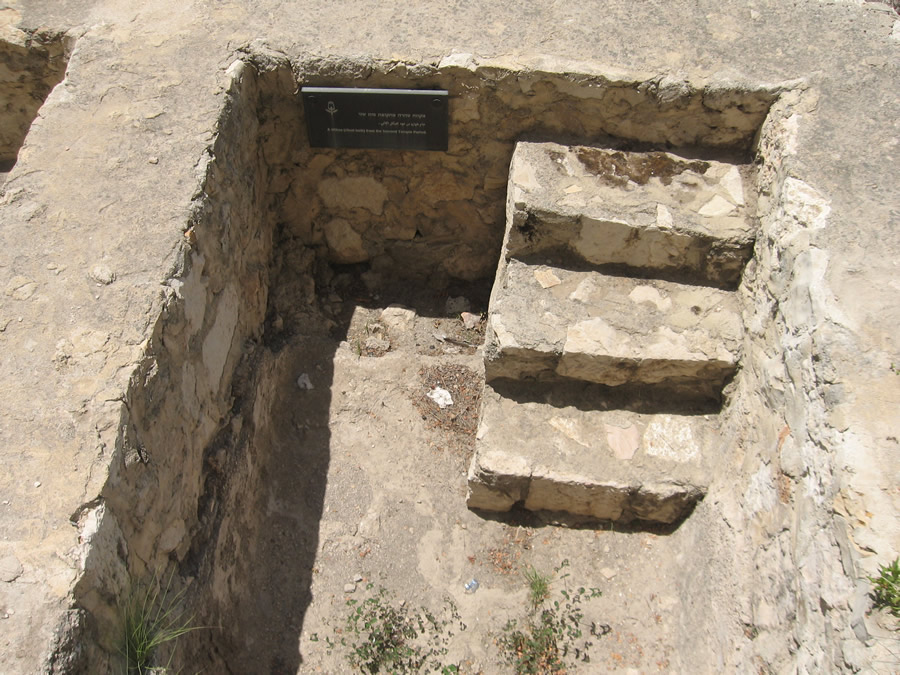
Archaeology has revealed large "baptistries" ("mikveh") around the Temple; people who were entering the Temple would go down the steps on one side of these baths, into the water, immerse themselves as a purification ritual, and then come out up the steps on the other side so as to not mix the pure path with the unpure path (ex., http://www.generationword.com/.../39-mikvah-ritual-baths...).

 
The Ethiopian eunuch of Acts 8 would have been witness to these Jewish baptisms all week long while he was in Jerusalem during Passover Week, wishing he could be baptized, sorrowful that he could not be part of God's community because of his status as an eunuch (Lev 21:18-20; Deut 23:1). Philip preached Jesus to him starting at Isaiah 53:7-8, and when they got three chapters further in (56:3ff), the Eunuch was excited that he might could now be part of God's community. When they came to some water, the eunuch's question was, "What's to keep me from being baptized?" And after he was baptized, he went on his way rejoicing that he could now be part of God's community.

Jesus had told the disciples that they would be his witnesses in Jerusalem, then in all Judea and Samaria, then to the ends of the earth (Acts 1:7). Luke shows this progression in his writing: conversion begins in Jerusalem, and includes the "Judean" (that is, full-blooded) Jews (Acts 2); then the half-Jews of Samaria (first half of Acts 8); then the disenfranchised, like eunuchs (second half of Acts 8); then the non-Jewish Gentiles who were favorable to the Jewish religion (Acts 10); then the somewhat-interested-in-Judaism Gentiles (Acts 13); then the pagans (Acts 14); more of the disenfranchised, like women and those working for the hated Roman government (Acts 16); then the snobbish elite heathen philosophers (Acts 17); then the king of the world himself and his worldly government (Acts 21-28). Luke is not trying to teach us that when Jesus is preached, baptism is part of that process (the eunuch was already familiar with baptism, albeit probably not the baptism of Jesus, which Philip would of necessity had to then explain, I'm confident); rather, he's developing his theme that those who were formerly excluded from the kingdom of God, such as the eunuch, are now welcome.


Originally published at:
http://kentwest.blogspot.com/2014/09/the-ethiopian-eunuchs-knew-about.html

Saturday, September 20, 2014

Why Don't Miracle-Workers Empty the Hospitals?

All my life I've heard the question, "If someone can heal the sick, why aren't they emptying the hospitals?", as an argument that healing must therefore not be happening today.

This is the same argument the inhabitants of Nazareth used against Jesus: "What
ever we heard was done at Capernaum, do here in your hometown as well.’ (Luke 4:16ff).

But look at Jesus' reply (paraphrased): "Look at Elijah; he did a miracle for ONE widow, and she was far away, when there were many widows right at his back door step. And Elisha; he healed ONE leper, a foreigner at that, when there were lots of lepers right there at his door."

And then the people hearing Jesus got furious with him.

Jesus says this argument is invalid.

Miracles have always been few and far between; they just seem like a lot in the Bible because the Bible condenses the story and focuses it so that it looks to us like those old "Biblical days" were the "Age of Miracles". Regardless of the existence or lack thereof of true miracles today, the argument that our hospitals aren't emptied by miracle-workers is not a valid argument against them.


Originally published at:
http://kentwest.blogspot.com/2014/09/why-dont-healers-empty-hospitals.html

Thursday, September 11, 2014

The Purpose of the Assembly

Many congregations have the misunderstanding that the assembly is primarily for the benefit of believers, not for unbelievers, and therefore orient their "service", particularly the sermon, to converting the unbeliever, making sure to offer an "Invitation" at the end of each sermon.

Yes, unbelievers may be in attendance, and may be converted as a result of the activities in the assembly (1 Cor 14:24-25), but Jesus said, "Go ye into all the world and make disciples," not "Go ye into all the church". The world is our mission field for converting unbelievers; the church is our place for building up & encouraging those who already believe (1 Cor 14:26b; Heb 10:25).

Originally published at:
http://kentwest.blogspot.com/2014/09/the-purpose-of-assembly.html

The Crux of Christianity

Gal 6:2 Carry one another’s burdens; in this way you will fulfill the law of Christ.

It doesn't matter that you're precisely on-time to your 9am Bible Class every Sunday morning; if you're not helping others in their daily struggles, you're not fulfilling the law of Christ.
James 2:8 Indeed, if you keep the royal law prescribed in the Scripture, Love your neighbor as yourself, you are doing well.
It doesn't matter that you can recite the entire Bible from memory, and know the differences between the covenant of Noah and that of Abraham; if you have the resources to get your neighbor's lawn mode during Zero-Toleration Week when he can't, so he doesn't get a ticket for grass that's too high, you're not fulfilling the Royal Law.
James 1:27 Pure and undefiled religion before our God and Father is this: to look after orphans and widows in their distress and to keep oneself unstained by the world.
It doesn't matter if you know all the correct doctrine, and break no rules of God, and meticulously keep the commands concerning worship and praise and church organization; if you're not making sure the widow woman has heat this winter and the orphan kids have shoes, you're not practicing pure and undefiled religion.
1 Cor 13:1 If I speak human or angelic languages but do not have love, I am a sounding gong or a clanging cymbal. If I have the gift of prophecy and understand all mysteries and all knowledge,
and if I have all faith so that I can move mountains but do not have love, I am nothing. And if I donate all my goods to feed the poor, and if I give my body in order to boast but do not have love, I gain nothing.
It doesn't matter if you have special miraculous capabilities, or extraordinary insight into Scripture, or a faith that drives to success, or even a self-sacrificing generosity; if it's not done out of love, it's no good.

The rich young ruler (Matt 19:16ff) had been a good kid all his life, keeping all the commands he knew to keep, but he still felt like maybe he wasn't good enough to be saved. Jesus told him that although he had kept all "the rules", that didn't matter; what mattered was having the right heart. The ruler wasn't willing to part with his big home and his fancy car and his fine art.

I recently saw a movie wherein the family of the main character had two vacation homes and spent no less than $10,000 per chair to redecorate the living room; this is the type of "rich young ruler" who doesn't see the family of five who's dad is working two jobs and who's mom is frantically trying to get the kids to school and to the dentist, who are struggling to pay the dentist, who are worried they won't be able to give the kids a decent Christmas or to be able to afford to let the kids go to Six Flags with the church group once a year.

The crux of Christianity is not about "keeping the rules"; it's about one-anotherness, "not looking to your own interests but to the interests of others" (Phil 2:4); helping those in need is the very reason for having a job (Eph 4:28).

Nothing wrong with "keeping the rules", particularly how we worship and what we teach in our assemblies; but we've tended to focus on that instead of the real fundamental of Christianity ("by this they will know you are my disciples, in that you love one another"- John 13:35). It's time we re-examine what we emphasize in our assemblies:
Heb 10: 24 And let us consider how we may spur one another on toward love and good deeds, not giving up meeting together, as some are in the habit of doing, but encouraging one another....
Originally published at:
http://kentwest.blogspot.com/2014/09/the-crux-of-christianity.html

The "Law" of First-Century Christianity, Part 2

In Part 1, I said that "God did not give us a bunch of rules. But we have such a need to have them, like children, we find the rules anyway...".

A reader wondered if that doesn't make Christianity a "lawless Religion". Here's my response:


[Gal 3:24] So that the law has become our tutor to bring us to Christ....

The law of Moses has taught us the basic concepts of righteousness: don't murder; don't steal; don't lie; respect your parents; be humane to animals; bathe regularly; honor YHWH only as God, not this god or that goddess; keep sexually/maritally pure; bathe regularly; etc.

Concerning the "lawless"-ness of Christianity: the laws are "written not with ink, but with the Spirit of the living God; not in tablets of stone, but in tablets that are hearts of flesh" (2 Cor 3:3b).

I once served on a grand jury, and the District Attorney, in giving us instructions, told us that if we ever had a question or a doubt about the process, to "do the right thing". Our hearts, having been tutored all our lives by rules/regulations/guidance from our parents/peers, "know" what's right and wrong (in general), without having to resort to a list of specific rules/regulations.

But as concerns specific rules/regulations....

[Col 2:20] If you died with Christ from the elements of the world, why, as though living in the world, do you subject yourselves to ordinances, [21] “Don’t handle, nor taste, nor touch”? ... [Gal 4:3] So we also, when we were children, were held in bondage under the elemental principles of the world. ... [9] But now that you have come to know God, or rather to be known by God, why do you turn back again to the weak and miserable elemental principles, to which you desire to be in bondage all over again? [10] You observe days, months, seasons, and years. ... [5:1] Stand firm therefore in the liberty by which Christ has made us free, and don’t be entangled again with a yoke of bondage. [13] For you, brothers, were called for freedom. Only don’t use your freedom for gain to the flesh, but through love be servants to one another. [14] For the whole law is fulfilled in one word, in this: “You shall love your neighbor as yourself.” ... [Jam 2:8] However, if you fulfill the royal law, according to the Scripture, “You shall love your neighbor as yourself,” you do well. ... [Gal 6:2] Bear one another’s burdens, and so fulfill the law of Christ. ... [Jam 1:27] Pure religion and undefiled before our God and Father is this: to visit the fatherless and widows in their affliction, and to keep oneself unstained by the world.

Specifically in regard to the Lord's Supper, I'm saying that Biblically, it seems it was a supper (at night), and it was a full-blown meal, perhaps observed annually at first (it started out as a new twist on the yearly Passover), or perhaps daily as early as Acts 2, but traditionally, at least as early as the late 1st century (in the Didache, with hints of the transformation in 1 Cor 11:23-29), it seems to have been whittled down into a weekly early-morning nip-and-sip. Neither the frequency nor the methodology are specifically commanded; as someone else has often written, the core of the command is to remember Jesus "as often" as you do "this". The apostolic teaching/examples neither condemn nor demand the timing or the size of the meal.

And yes, that is uncomfortable. Like children who want to know the exact limits of the rules mommy and daddy have laid down, we test the "edge cases"; Can we do this? What about that? It's time to "no longer be children, tossed back and forth and carried about with every wind of doctrine, by the trickery of men, in craftiness, after the wiles of error; [15] but speaking truth in love, we may grow up in all things into him, who is the head, Christ" (Eph 4:14-15, & read the rest of the chapter).


Originally published at:
http://kentwest.blogspot.com/2014/09/the-law-of-first-century-christianity_11.html

The "Law" of First-Century Christianity, Part 1

In responding to someone who objected to my claim that "there is no command as to how exactly all Christians of all times are to observe the Lord's Supper", I wrote the following:

In the very earliest days, the church was steadfast in the apostles' teaching: they met daily in the Temple (big group) and in homes (small groups; each led by a shepherd?), they broke bread together daily, and they lived as communists, with no one claiming private ownership of property but contributing their stuff to the group for distribution as needed.

In later times and other places, the "steadfastness" abated somewhat, necessitating the writing of much of the New Testament as a corrective.

Along the way, the church changed as time passed:
  • it was originally composed of Jews only, who remained observant of the law of Moses, and later accepted non-Moses-observing non-Jews into the fold as a distinct sub-group (i.e. "denomination", which "seemed good" to the Holy Spirit and to the church leaders), to an even later change wherein observance of the law of Moses was rejected almost entirely, along with an overall rejection of Jews;
  • ownership of private property was re-established, leading to the need for fund-raising appeals/drives;
  • the organizational structure was modified, adding deacons;
  • the political structure was modified, moving from a centralized government in Jerusalem making decisions binding on the entire church to a distributed localized autonomy led by local elders;
  • the Lord's Suppers morphed from being a full-blown daily evening meal which fed the hungry into a simpler ritual of a nip-and-a-sip morning Lord's Brunch;
  • there was a move from a daily everyone-participates meeting where the focus was horizontally on one-another to a weekly passive sit&listen-to-a-lecture format which became focused vertically on "worship";
  • there was a shift from the Law of Christ being fulfilled by bearing one another's burdens to it being fulfilled by a system of doctrine & practices (which, by the way, isn't spelled out clearly like the Old Covenant system was, but must be "discovered" between the lines by using the correct hermeneutic);
  • there was a shift from being known as disciples because of their love for one another to being known as disciples because of correct doctrine and practices;
  • there was a shift from being filled with the spirit and fanning that flame, to a quenching of the spirit so that his activity is reduced to only the effects which are produced by words on paper.
Depending where along the time-line you take your snapshot of "the first-century church", you'll get different pictures.

It would have been much clearer if God had simply given us a list of rules to keep, the way he did in the old covenant, but he had promised that the new would not be like the old, with its rules written down on stone and papyrus, but one of relationship where God would be with us and we wouldn't need someone to teach us rules, one which Paul says we keep in spirit rather than by the letter of the law.

So keeping to his promise, God did not give us a bunch of rules. But we have such a need to have them, like children, we find the rules anyway by focusing on this example or that inference, and condemn anyone who discerns different rules than what we've found.

The fact remains that "there is no command as to how exactly all Christians of all times are to observe the Lord's Supper".

Go to Part 2

Originally published at:
http://kentwest.blogspot.com/2014/09/the-law-of-first-century-christianity.html