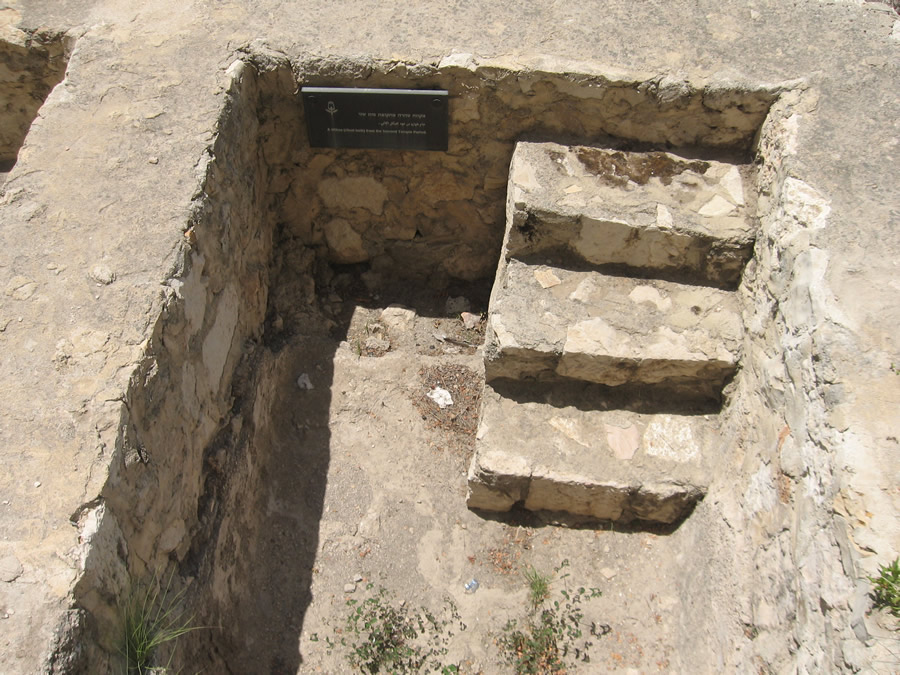
Archaeology
has revealed large "baptistries" ("mikveh") around the Temple; people
who were entering the Temple would go down the steps on one side of
these baths, into the water, immerse themselves as a purification
ritual, and then come out up the steps on the other side so as to not
mix the pure path with the unpure path (ex., http://www.generationword.com/.../39-mikvah-ritual-baths...).
The Ethiopian eunuch of Acts 8 would have been
witness to these Jewish baptisms all week long while he was in Jerusalem
during Passover Week, wishing he could be baptized, sorrowful that he
could not be part of God's community because of his status as an eunuch
(Lev 21:18-20; Deut 23:1). Philip preached Jesus to him starting at
Isaiah 53:7-8, and when they got three chapters further in (56:3ff), the
Eunuch was excited that he might could now be part of God's community.
When they came to some water, the eunuch's question was, "What's to keep
me from being baptized?" And after he was baptized, he went on his
way rejoicing that he could now be part of God's community.
Jesus
had told the disciples that they would be his witnesses in Jerusalem,
then in all Judea and Samaria, then to the ends of the earth (Acts 1:7).
Luke shows this progression in his writing: conversion begins in
Jerusalem, and includes the "Judean" (that is, full-blooded) Jews (Acts
2); then the half-Jews of Samaria (first half of Acts 8); then the
disenfranchised, like eunuchs (second half of Acts 8); then the
non-Jewish Gentiles who were favorable to the Jewish religion (Acts 10);
then the somewhat-interested-in-Judaism Gentiles (Acts 13); then the
pagans (Acts 14); more of the disenfranchised, like women and those
working for the hated Roman government (Acts 16); then the snobbish
elite heathen philosophers (Acts 17); then the king of the world himself
and his worldly government (Acts 21-28). Luke is not trying to teach us
that when Jesus is preached, baptism is part of that process (the
eunuch was already familiar with baptism, albeit probably not the
baptism of Jesus, which Philip would of necessity had to then explain,
I'm confident); rather, he's developing his theme that those who were
formerly excluded from the kingdom of God, such as the eunuch, are now
welcome.
Originally published at:
http://kentwest.blogspot.com/2014/09/the-ethiopian-eunuchs-knew-about.html
Monday, September 22, 2014
Saturday, September 20, 2014
Why Don't Miracle-Workers Empty the Hospitals?
All
my life I've heard the question, "If someone can heal the sick, why
aren't they emptying the hospitals?", as an argument that healing must
therefore not be happening today.
This is the same argument the inhabitants of Nazareth used against Jesus: "Whatever we heard was done at Capernaum, do here in your hometown as well.’ (Luke 4:16ff).
But look at Jesus' reply (paraphrased): "Look at Elijah; he did a miracle for ONE widow, and she was far away, when there were many widows right at his back door step. And Elisha; he healed ONE leper, a foreigner at that, when there were lots of lepers right there at his door."
And then the people hearing Jesus got furious with him.
Jesus says this argument is invalid.
Miracles have always been few and far between; they just seem like a lot in the Bible because the Bible condenses the story and focuses it so that it looks to us like those old "Biblical days" were the "Age of Miracles". Regardless of the existence or lack thereof of true miracles today, the argument that our hospitals aren't emptied by miracle-workers is not a valid argument against them.
Originally published at:
http://kentwest.blogspot.com/2014/09/why-dont-healers-empty-hospitals.html
This is the same argument the inhabitants of Nazareth used against Jesus: "Whatever we heard was done at Capernaum, do here in your hometown as well.’ (Luke 4:16ff).
But look at Jesus' reply (paraphrased): "Look at Elijah; he did a miracle for ONE widow, and she was far away, when there were many widows right at his back door step. And Elisha; he healed ONE leper, a foreigner at that, when there were lots of lepers right there at his door."
And then the people hearing Jesus got furious with him.
Jesus says this argument is invalid.
Miracles have always been few and far between; they just seem like a lot in the Bible because the Bible condenses the story and focuses it so that it looks to us like those old "Biblical days" were the "Age of Miracles". Regardless of the existence or lack thereof of true miracles today, the argument that our hospitals aren't emptied by miracle-workers is not a valid argument against them.
Originally published at:
http://kentwest.blogspot.com/2014/09/why-dont-healers-empty-hospitals.html
Thursday, September 11, 2014
The Purpose of the Assembly
Many congregations have the
misunderstanding that the assembly is primarily for the benefit of
believers, not for unbelievers, and therefore orient their "service", particularly the sermon, to converting the unbeliever, making sure to offer an "Invitation" at the end of each sermon.
Yes, unbelievers may be in attendance, and may be converted as a result of the activities in the assembly (1 Cor 14:24-25), but Jesus said, "Go ye into all the world and make disciples," not "Go ye into all the church". The world is our mission field for converting unbelievers; the church is our place for building up & encouraging those who already believe (1 Cor 14:26b; Heb 10:25).
Originally published at:
http://kentwest.blogspot.com/2014/09/the-purpose-of-assembly.html
Yes, unbelievers may be in attendance, and may be converted as a result of the activities in the assembly (1 Cor 14:24-25), but Jesus said, "Go ye into all the world and make disciples," not "Go ye into all the church". The world is our mission field for converting unbelievers; the church is our place for building up & encouraging those who already believe (1 Cor 14:26b; Heb 10:25).
Originally published at:
http://kentwest.blogspot.com/2014/09/the-purpose-of-assembly.html
The Crux of Christianity
Gal 6:2 Carry one another’s burdens; in this way you will fulfill the law of Christ.
It doesn't matter that you're precisely on-time to your 9am Bible Class every Sunday morning; if you're not helping others in their daily struggles, you're not fulfilling the law of Christ.
James 2:8 Indeed, if you keep the royal law prescribed in the Scripture, Love your neighbor as yourself, you are doing well.It doesn't matter that you can recite the entire Bible from memory, and know the differences between the covenant of Noah and that of Abraham; if you have the resources to get your neighbor's lawn mode during Zero-Toleration Week when he can't, so he doesn't get a ticket for grass that's too high, you're not fulfilling the Royal Law.
James 1:27 Pure and undefiled religion before our God and Father is this: to look after orphans and widows in their distress and to keep oneself unstained by the world.It doesn't matter if you know all the correct doctrine, and break no rules of God, and meticulously keep the commands concerning worship and praise and church organization; if you're not making sure the widow woman has heat this winter and the orphan kids have shoes, you're not practicing pure and undefiled religion.
1 Cor 13:1 If I speak human or angelic languages but do not have love, I am a sounding gong or a clanging cymbal. If I have the gift of prophecy and understand all mysteries and all knowledge,It doesn't matter if you have special miraculous capabilities, or extraordinary insight into Scripture, or a faith that drives to success, or even a self-sacrificing generosity; if it's not done out of love, it's no good.
and if I have all faith so that I can move mountains but do not have love, I am nothing. And if I donate all my goods to feed the poor, and if I give my body in order to boast but do not have love, I gain nothing.
The rich young ruler (Matt 19:16ff) had been a good kid all his life, keeping all the commands he knew to keep, but he still felt like maybe he wasn't good enough to be saved. Jesus told him that although he had kept all "the rules", that didn't matter; what mattered was having the right heart. The ruler wasn't willing to part with his big home and his fancy car and his fine art.
I recently saw a movie wherein the family of the main character had two vacation homes and spent no less than $10,000 per chair to redecorate the living room; this is the type of "rich young ruler" who doesn't see the family of five who's dad is working two jobs and who's mom is frantically trying to get the kids to school and to the dentist, who are struggling to pay the dentist, who are worried they won't be able to give the kids a decent Christmas or to be able to afford to let the kids go to Six Flags with the church group once a year.
The crux of Christianity is not about "keeping the rules"; it's about one-anotherness, "not looking to your own interests but to the interests of others" (Phil 2:4); helping those in need is the very reason for having a job (Eph 4:28).
Nothing wrong with "keeping the rules", particularly how we worship and what we teach in our assemblies; but we've tended to focus on that instead of the real fundamental of Christianity ("by this they will know you are my disciples, in that you love one another"- John 13:35). It's time we re-examine what we emphasize in our assemblies:
Heb 10: 24 And let us consider how we may spur one another on toward love and good deeds, not giving up meeting together, as some are in the habit of doing, but encouraging one another....Originally published at:
http://kentwest.blogspot.com/2014/09/the-crux-of-christianity.html
The "Law" of First-Century Christianity, Part 2
In Part 1, I said that "God did not give us a
bunch of rules. But we have such a need to have them, like children, we
find the rules anyway...".
A reader wondered if that doesn't make Christianity a "lawless Religion". Here's my response:
[Gal 3:24] So that the law has become our tutor to bring us to Christ....
The law of Moses has taught us the basic concepts of righteousness: don't murder; don't steal; don't lie; respect your parents; be humane to animals; bathe regularly; honor YHWH only as God, not this god or that goddess; keep sexually/maritally pure; bathe regularly; etc.
Concerning the "lawless"-ness of Christianity: the laws are "written not with ink, but with the Spirit of the living God; not in tablets of stone, but in tablets that are hearts of flesh" (2 Cor 3:3b).
I once served on a grand jury, and the District Attorney, in giving us instructions, told us that if we ever had a question or a doubt about the process, to "do the right thing". Our hearts, having been tutored all our lives by rules/regulations/guidance from our parents/peers, "know" what's right and wrong (in general), without having to resort to a list of specific rules/regulations.
But as concerns specific rules/regulations....
[Col 2:20] If you died with Christ from the elements of the world, why, as though living in the world, do you subject yourselves to ordinances, [21] “Don’t handle, nor taste, nor touch”? ... [Gal 4:3] So we also, when we were children, were held in bondage under the elemental principles of the world. ... [9] But now that you have come to know God, or rather to be known by God, why do you turn back again to the weak and miserable elemental principles, to which you desire to be in bondage all over again? [10] You observe days, months, seasons, and years. ... [5:1] Stand firm therefore in the liberty by which Christ has made us free, and don’t be entangled again with a yoke of bondage. [13] For you, brothers, were called for freedom. Only don’t use your freedom for gain to the flesh, but through love be servants to one another. [14] For the whole law is fulfilled in one word, in this: “You shall love your neighbor as yourself.” ... [Jam 2:8] However, if you fulfill the royal law, according to the Scripture, “You shall love your neighbor as yourself,” you do well. ... [Gal 6:2] Bear one another’s burdens, and so fulfill the law of Christ. ... [Jam 1:27] Pure religion and undefiled before our God and Father is this: to visit the fatherless and widows in their affliction, and to keep oneself unstained by the world.
Specifically in regard to the Lord's Supper, I'm saying that Biblically, it seems it was a supper (at night), and it was a full-blown meal, perhaps observed annually at first (it started out as a new twist on the yearly Passover), or perhaps daily as early as Acts 2, but traditionally, at least as early as the late 1st century (in the Didache, with hints of the transformation in 1 Cor 11:23-29), it seems to have been whittled down into a weekly early-morning nip-and-sip. Neither the frequency nor the methodology are specifically commanded; as someone else has often written, the core of the command is to remember Jesus "as often" as you do "this". The apostolic teaching/examples neither condemn nor demand the timing or the size of the meal.
And yes, that is uncomfortable. Like children who want to know the exact limits of the rules mommy and daddy have laid down, we test the "edge cases"; Can we do this? What about that? It's time to "no longer be children, tossed back and forth and carried about with every wind of doctrine, by the trickery of men, in craftiness, after the wiles of error; [15] but speaking truth in love, we may grow up in all things into him, who is the head, Christ" (Eph 4:14-15, & read the rest of the chapter).
Originally published at:
http://kentwest.blogspot.com/2014/09/the-law-of-first-century-christianity_11.html
A reader wondered if that doesn't make Christianity a "lawless Religion". Here's my response:
[Gal 3:24] So that the law has become our tutor to bring us to Christ....
The law of Moses has taught us the basic concepts of righteousness: don't murder; don't steal; don't lie; respect your parents; be humane to animals; bathe regularly; honor YHWH only as God, not this god or that goddess; keep sexually/maritally pure; bathe regularly; etc.
Concerning the "lawless"-ness of Christianity: the laws are "written not with ink, but with the Spirit of the living God; not in tablets of stone, but in tablets that are hearts of flesh" (2 Cor 3:3b).
I once served on a grand jury, and the District Attorney, in giving us instructions, told us that if we ever had a question or a doubt about the process, to "do the right thing". Our hearts, having been tutored all our lives by rules/regulations/guidance from our parents/peers, "know" what's right and wrong (in general), without having to resort to a list of specific rules/regulations.
But as concerns specific rules/regulations....
[Col 2:20] If you died with Christ from the elements of the world, why, as though living in the world, do you subject yourselves to ordinances, [21] “Don’t handle, nor taste, nor touch”? ... [Gal 4:3] So we also, when we were children, were held in bondage under the elemental principles of the world. ... [9] But now that you have come to know God, or rather to be known by God, why do you turn back again to the weak and miserable elemental principles, to which you desire to be in bondage all over again? [10] You observe days, months, seasons, and years. ... [5:1] Stand firm therefore in the liberty by which Christ has made us free, and don’t be entangled again with a yoke of bondage. [13] For you, brothers, were called for freedom. Only don’t use your freedom for gain to the flesh, but through love be servants to one another. [14] For the whole law is fulfilled in one word, in this: “You shall love your neighbor as yourself.” ... [Jam 2:8] However, if you fulfill the royal law, according to the Scripture, “You shall love your neighbor as yourself,” you do well. ... [Gal 6:2] Bear one another’s burdens, and so fulfill the law of Christ. ... [Jam 1:27] Pure religion and undefiled before our God and Father is this: to visit the fatherless and widows in their affliction, and to keep oneself unstained by the world.
Specifically in regard to the Lord's Supper, I'm saying that Biblically, it seems it was a supper (at night), and it was a full-blown meal, perhaps observed annually at first (it started out as a new twist on the yearly Passover), or perhaps daily as early as Acts 2, but traditionally, at least as early as the late 1st century (in the Didache, with hints of the transformation in 1 Cor 11:23-29), it seems to have been whittled down into a weekly early-morning nip-and-sip. Neither the frequency nor the methodology are specifically commanded; as someone else has often written, the core of the command is to remember Jesus "as often" as you do "this". The apostolic teaching/examples neither condemn nor demand the timing or the size of the meal.
And yes, that is uncomfortable. Like children who want to know the exact limits of the rules mommy and daddy have laid down, we test the "edge cases"; Can we do this? What about that? It's time to "no longer be children, tossed back and forth and carried about with every wind of doctrine, by the trickery of men, in craftiness, after the wiles of error; [15] but speaking truth in love, we may grow up in all things into him, who is the head, Christ" (Eph 4:14-15, & read the rest of the chapter).
Originally published at:
http://kentwest.blogspot.com/2014/09/the-law-of-first-century-christianity_11.html
The "Law" of First-Century Christianity, Part 1
In responding to someone who objected to my claim that "there is no command as to how exactly all Christians of all times are to observe the Lord's Supper", I wrote the following:
In the very earliest days, the church was steadfast in the apostles' teaching: they met daily in the Temple (big group) and in homes (small groups; each led by a shepherd?), they broke bread together daily, and they lived as communists, with no one claiming private ownership of property but contributing their stuff to the group for distribution as needed.
In later times and other places, the "steadfastness" abated somewhat, necessitating the writing of much of the New Testament as a corrective.
Along the way, the church changed as time passed:
It would have been much clearer if God had simply given us a list of rules to keep, the way he did in the old covenant, but he had promised that the new would not be like the old, with its rules written down on stone and papyrus, but one of relationship where God would be with us and we wouldn't need someone to teach us rules, one which Paul says we keep in spirit rather than by the letter of the law.
So keeping to his promise, God did not give us a bunch of rules. But we have such a need to have them, like children, we find the rules anyway by focusing on this example or that inference, and condemn anyone who discerns different rules than what we've found.
The fact remains that "there is no command as to how exactly all Christians of all times are to observe the Lord's Supper".
Go to Part 2
Originally published at:
http://kentwest.blogspot.com/2014/09/the-law-of-first-century-christianity.html
In the very earliest days, the church was steadfast in the apostles' teaching: they met daily in the Temple (big group) and in homes (small groups; each led by a shepherd?), they broke bread together daily, and they lived as communists, with no one claiming private ownership of property but contributing their stuff to the group for distribution as needed.
In later times and other places, the "steadfastness" abated somewhat, necessitating the writing of much of the New Testament as a corrective.
Along the way, the church changed as time passed:
- it was originally composed of Jews only, who remained observant of the law of Moses, and later accepted non-Moses-observing non-Jews into the fold as a distinct sub-group (i.e. "denomination", which "seemed good" to the Holy Spirit and to the church leaders), to an even later change wherein observance of the law of Moses was rejected almost entirely, along with an overall rejection of Jews;
- ownership of private property was re-established, leading to the need for fund-raising appeals/drives;
- the organizational structure was modified, adding deacons;
- the political structure was modified, moving from a centralized government in Jerusalem making decisions binding on the entire church to a distributed localized autonomy led by local elders;
- the Lord's Suppers morphed from being a full-blown daily evening meal which fed the hungry into a simpler ritual of a nip-and-a-sip morning Lord's Brunch;
- there was a move from a daily everyone-participates meeting where the focus was horizontally on one-another to a weekly passive sit&listen-to-a-lecture format which became focused vertically on "worship";
- there was a shift from the Law of Christ being fulfilled by bearing one another's burdens to it being fulfilled by a system of doctrine & practices (which, by the way, isn't spelled out clearly like the Old Covenant system was, but must be "discovered" between the lines by using the correct hermeneutic);
- there was a shift from being known as disciples because of their love for one another to being known as disciples because of correct doctrine and practices;
- there was a shift from being filled with the spirit and fanning that flame, to a quenching of the spirit so that his activity is reduced to only the effects which are produced by words on paper.
It would have been much clearer if God had simply given us a list of rules to keep, the way he did in the old covenant, but he had promised that the new would not be like the old, with its rules written down on stone and papyrus, but one of relationship where God would be with us and we wouldn't need someone to teach us rules, one which Paul says we keep in spirit rather than by the letter of the law.
So keeping to his promise, God did not give us a bunch of rules. But we have such a need to have them, like children, we find the rules anyway by focusing on this example or that inference, and condemn anyone who discerns different rules than what we've found.
The fact remains that "there is no command as to how exactly all Christians of all times are to observe the Lord's Supper".
Go to Part 2
Originally published at:
http://kentwest.blogspot.com/2014/09/the-law-of-first-century-christianity.html
Wednesday, August 20, 2014
Dividing, or Not, Over Divisive Issues
It's inevitable that issues will arise over which two parties disagree. When this happens, I can think of only five possibilities to resolve the difference. For example, if half of your home church congregation believes hands should not be
raised in the assembly, and the other half thinks it's a good thing, here are the five options:
1. One party persuades the other party of their position. For example, the hand-raising half convinces the non-hand-raising half that hand-raising in the assembly is Biblical (or vice-versa). Unity is retained.
2. One party submits to the other party, without being persuaded. For example, the hand-raising half continues believing it's a good thing, but refrains from raising hands in the assembly in order to remain in harmony with the non-hand-raising half. Unity is retained.
3. Both parties tolerate the disagreement without splitting up. Some raise their hands in the assembly, and some don't, recognizing that each servant is accountable to God, not to "me". Unity is retained.
4. The two parties split up for "irreconcilable differences", but amicably, retaining a "one-ness" in heart while not necessarily in mindset. A separate congregation is formed so that hands can be raised in one assembly but not the other, yet the two sister congregations otherwise retain full fellowship with one another. Unity is retained.
5. The two parties split up, and "divorce" one another, making the issue a "test of fellowship". Likely, at least one of the two halves declares the other "liberal" or "legalistic', and "apostate". Unity is lost.
"Unity" does not mean "uniformitarianism". A wife and a husband may disagree strongly with one issue or another, but that shouldn't break their basic unity. It's the same with Christian unity.
Originally published at:
1. One party persuades the other party of their position. For example, the hand-raising half convinces the non-hand-raising half that hand-raising in the assembly is Biblical (or vice-versa). Unity is retained.
2. One party submits to the other party, without being persuaded. For example, the hand-raising half continues believing it's a good thing, but refrains from raising hands in the assembly in order to remain in harmony with the non-hand-raising half. Unity is retained.
3. Both parties tolerate the disagreement without splitting up. Some raise their hands in the assembly, and some don't, recognizing that each servant is accountable to God, not to "me". Unity is retained.
4. The two parties split up for "irreconcilable differences", but amicably, retaining a "one-ness" in heart while not necessarily in mindset. A separate congregation is formed so that hands can be raised in one assembly but not the other, yet the two sister congregations otherwise retain full fellowship with one another. Unity is retained.
5. The two parties split up, and "divorce" one another, making the issue a "test of fellowship". Likely, at least one of the two halves declares the other "liberal" or "legalistic', and "apostate". Unity is lost.
"Unity" does not mean "uniformitarianism". A wife and a husband may disagree strongly with one issue or another, but that shouldn't break their basic unity. It's the same with Christian unity.
Originally published at:
http://kentwest.blogspot.com/2014/08/dividing-or-not-over-divisive-issues.html
Sunday, August 10, 2014
Notes on the "Church of Christ"
1. "church" is probably not a particularly good word for translating what Jesus promised to build, "ekklesia", which is better translated as "community" or "assembly", or even better, "those called-out into an assembly" (which is admittedly somewhat unwieldy). The earliest translators of the Bible into English knew better than to translate the word as "church", but when King James gave his approval for an English translation, one of his 14 rules upon which he insisted was to keep the old Catholic words like "baptize" and "church", thereby keeping the baggage that goes along with those words.
The point is that Jesus didn't build an organization so much as he built an organism. It might seem like a minor thing, but the concept reaches far into how we perceive our mission.
2. The church of christ in Corinth had splintered into denominations. Paul said this shouldn't be, but even so, he considered these denominational members as saints, members of the church of God (1 Cor 1:2, 10ff).
3. The "church of God" is, as are many other terms, just as Biblical as "church of Christ".
4. In Acts 15:28, it "seemed good to the Holy Spirit" and to the church leaders and apostles, that the church be composed of two distinct groups, having different practices (one observed the law of Moses; one didn't). We see this same division elsewhere in the New Testament. Yet these two "denominations" were united as one body, united in spirit but not practice, nor even in name (e.g., "Circumcision" vs "Non-Circumcision). Even when one group sees a particular issue as sinful and the other group does not, the apostle instructs the "freer" group to sacrifice their freedom for the sake of the weaker group, without necessarily "believing the same things" (Rom 14). "Being of like mind" does not mean "believing exactly alike"; it means staying united despite having different ways of seeing things.
5. Any person properly converted is added by the Lord to his ekklesia. Even if that person mistakenly believes himself to be an Apollosite or a Baptist, he's still a member of the church of Jesus Christ, just one who is in error, like those Corinthian Christians. (But then, who of us is not in error in some unknown way, at some point in our walk with Christ?) Such a person should heed the call to come out of those man-made organizations, to be in nothing more than the called-out assembly of Christ.
Originally published at:
http://kentwest.blogspot.com/2014/08/notes-on-church-of-christ.html
The point is that Jesus didn't build an organization so much as he built an organism. It might seem like a minor thing, but the concept reaches far into how we perceive our mission.
2. The church of christ in Corinth had splintered into denominations. Paul said this shouldn't be, but even so, he considered these denominational members as saints, members of the church of God (1 Cor 1:2, 10ff).
3. The "church of God" is, as are many other terms, just as Biblical as "church of Christ".
4. In Acts 15:28, it "seemed good to the Holy Spirit" and to the church leaders and apostles, that the church be composed of two distinct groups, having different practices (one observed the law of Moses; one didn't). We see this same division elsewhere in the New Testament. Yet these two "denominations" were united as one body, united in spirit but not practice, nor even in name (e.g., "Circumcision" vs "Non-Circumcision). Even when one group sees a particular issue as sinful and the other group does not, the apostle instructs the "freer" group to sacrifice their freedom for the sake of the weaker group, without necessarily "believing the same things" (Rom 14). "Being of like mind" does not mean "believing exactly alike"; it means staying united despite having different ways of seeing things.
5. Any person properly converted is added by the Lord to his ekklesia. Even if that person mistakenly believes himself to be an Apollosite or a Baptist, he's still a member of the church of Jesus Christ, just one who is in error, like those Corinthian Christians. (But then, who of us is not in error in some unknown way, at some point in our walk with Christ?) Such a person should heed the call to come out of those man-made organizations, to be in nothing more than the called-out assembly of Christ.
Originally published at:
http://kentwest.blogspot.com/2014/08/notes-on-church-of-christ.html
Sunday, August 03, 2014
The "Worship Assembly" is Foreign to the New Testament
The concept of a "worship assembly" is foreign to the New Testament.
The assembly in Heb 10:25 is an "irritate one another to love and good works" assembly (v. 24).
The assembly in 1 Cor 11:17ff is one in which we're supposed to focus not on ourselves, but on the body, on each other, making sure the poor get a portion of the community meal.
The assembly in Acts 20 starts as a long-winded lecture, but concludes as an all-night discussion (see the Greek for this distinction if your English translation doesn't make it clear).
Concerning the assembly in 1 Cor 14, we're specifically told that "all things in the assembly must be for edification" (v. 26); we're not told that things in the assembly are to be for worship. The entire description in this chapter is that "all of you ..., one by one" can use his God-given gifts to build up the others, so that "all may learn, and all may be exhorted" (v. 31). When the unbeliever comes in, he's not convicted by the preacher's sermon; rather he's "reproved by all", "judged by all", revealing the secrets of his heart, bringing him to a new-found conviction to worship God (vv 24-25).
Our modern day assemblies are not geared so that each person contributes something that "irritates" the others to love and to good works and to being built up.
In the New Testament, we see sermons preached to non-Christians in the streets and in the pagan temples and in the Jewish synagogues, but in the assemblies of Christ, the sermon gives way to an "everyone participation". Until we do this, our assemblies may be "our way", but they're not what we see in the New Testament.
Originally published at:
The assembly in Heb 10:25 is an "irritate one another to love and good works" assembly (v. 24).
The assembly in 1 Cor 11:17ff is one in which we're supposed to focus not on ourselves, but on the body, on each other, making sure the poor get a portion of the community meal.
The assembly in Acts 20 starts as a long-winded lecture, but concludes as an all-night discussion (see the Greek for this distinction if your English translation doesn't make it clear).
Concerning the assembly in 1 Cor 14, we're specifically told that "all things in the assembly must be for edification" (v. 26); we're not told that things in the assembly are to be for worship. The entire description in this chapter is that "all of you ..., one by one" can use his God-given gifts to build up the others, so that "all may learn, and all may be exhorted" (v. 31). When the unbeliever comes in, he's not convicted by the preacher's sermon; rather he's "reproved by all", "judged by all", revealing the secrets of his heart, bringing him to a new-found conviction to worship God (vv 24-25).
Our modern day assemblies are not geared so that each person contributes something that "irritates" the others to love and to good works and to being built up.
In the New Testament, we see sermons preached to non-Christians in the streets and in the pagan temples and in the Jewish synagogues, but in the assemblies of Christ, the sermon gives way to an "everyone participation". Until we do this, our assemblies may be "our way", but they're not what we see in the New Testament.
Originally published at:
http://kentwest.blogspot.com/2014/08/the-worship-assembly-is-foreign-to-new.html
Tuesday, July 22, 2014
The Privacy of Giving, &tc
But when you give to the poor, don’t let your left hand know what your right hand is doing, so that your giving may be in secret.And yet, when we take up a collection at church, we pass around a plate, making it obvious to all what is (or is not) being put into the contribution (especially on Sunday nights in some congregations, in which individuals are less-able to blend into the crowd).
-- Jesus, Matthew 6:3-4a
Some churches use a soft cloth bag, which adds privacy and which protects against spills in case of a drop, but also perhaps adds to the potential of having funds stolen out of the bag.
The Temple used a drop-box (Mark 12:41), but it also offered no privacy. (I think a locked drop-box would work well at the doors of a building, encouraging even small gifts of pocket-change as one walks in/out of the building.)
The early church was well aware of some big contributions by individuals (Acts 4:36-5:11), thus demonstrating that the early church didn't always get all the details quite right in following Jesus' teachings (see his teaching in quotation above).
Should we rethink our plate-passing tradition in favor of something more private?
Should churches offer an auto-debit plan from a bank account, or on-demand credit/debit-card capability?
Should the average Christian in the pew have the power to distinguish between giving a gift for the poor[1] and giving a gift to the on-going work of the congregation[2], or should that budget decision be solely in the hands of the elders?
I ask these questions because we get comfortable in our traditions, and sometimes those traditions then become man-made commands, which we then teach as doctrine, which as we all know is "vain worship". And sometimes questioning can lead to a better, more efficient, sometimes even more Biblical, way of doing things. For example, would it be more Biblical to make our giving more private than passing around a plate in full-view of everyone? It's good to question every so often why we do things the way we do them.
Footnotes:
-----
1. 1 Cor 16:1ff (which was a one-time year-long fundraiser as per 2 Cor 8), and its related passages in Acts 11:27-30; Romans 15:25-28; Acts 24:17; Gal 2:10
2. 1 Cor 9:1-18, esp v. 14; 1 Tim 5:17-18; Phil 4:10ff
Originally published at:
http://kentwest.blogspot.com/2014/07/the-privacy-of-giving.html
Thursday, July 03, 2014
Pray with the Spirit / Pray with the Understanding
In my church circles, the following passage is often used in an unscriptural manner:
But this just highlights how easy it is to take Scripture out of context. If we read the verse above out of context, it sounds exactly how it is often used - that we're to be fully aware of what we're singing/praying at all times, and we're to be sincere about it.
But in context, that's not what the phrase says at all.
Throughout this entire chapter, Paul is contrasting the value of heart-felt sincerity in worship versus educational, church-strengthening information.
He's not saying we should do both at the same time; he's saying there's a time and a place for "brain-dead", "spirit-based" worship, and there's a time and a place for "brain fully-engaged" thinking. And he will do both. Not at the same time, but when each is appropriate.
His emphasis throughout the entire chapter is that in the assembly (i.e., when we "do church" with others), the spiritual worship is inappropriate, and only the understandable worship is appropriate.
Notice how he makes the contrast starting in the very beginning of the chapter, starting at verse 1 (I'm going to switch away from the KJV to a more understandable version, the Holman Christian Standard Bible):
He continues with this thought, but I'll skip a fair portion of it and jump to verse 13:
When we try to use this passage to teach that we are to sing/pray with the spirit at the same time that we sing/pray with the understanding, we have changed the meaning of "with the Spirit" to something other than what the Scriptures actually say. We have become unscriptural.
Originally published at:
http://kentwest.blogspot.com/2014/07/pray-with-spirit-pray-with-understanding.html
KJV 1 Cor 14:15 What is it then? I will pray with the spirit, and I will pray with the understanding also: I will sing with the spirit, and I will sing with the understanding also.Nearly always the meaning is that our singing/praying is to be done with a heartfelt sincerity, and with full understanding of what we're singing/praying about.
But this just highlights how easy it is to take Scripture out of context. If we read the verse above out of context, it sounds exactly how it is often used - that we're to be fully aware of what we're singing/praying at all times, and we're to be sincere about it.
But in context, that's not what the phrase says at all.
Throughout this entire chapter, Paul is contrasting the value of heart-felt sincerity in worship versus educational, church-strengthening information.
He's not saying we should do both at the same time; he's saying there's a time and a place for "brain-dead", "spirit-based" worship, and there's a time and a place for "brain fully-engaged" thinking. And he will do both. Not at the same time, but when each is appropriate.
His emphasis throughout the entire chapter is that in the assembly (i.e., when we "do church" with others), the spiritual worship is inappropriate, and only the understandable worship is appropriate.
Notice how he makes the contrast starting in the very beginning of the chapter, starting at verse 1 (I'm going to switch away from the KJV to a more understandable version, the Holman Christian Standard Bible):
Pursue love and desire spiritual gifts, and above all that you may prophesy. For the person who speaks in another language is not speaking to men but to God, since no one understands him; however, he speaks mysteries in the Spirit. But the person who prophesies speaks to people for edification, encouragement, and consolation. The person who speaks in another language builds himself up, but he who prophesies builds up the church. I wish all of you spoke in other languages, but even more that you prophesied. The person who prophesies is greater than the person who speaks in languages, unless he interprets so that the church may be built up.Notice that speaking in another language is not speaking to men, but to God, and is mysterious.
He continues with this thought, but I'll skip a fair portion of it and jump to verse 13:
Therefore the person who speaks in another language should pray that he can interpret. For if I pray in another language, my spirit prays, but my understanding is unfruitful. What then? I will pray with the spirit, and I will also pray with my understanding. I will sing with the spirit, and I will also sing with my understanding. Otherwise, if you praise with the spirit, how will the uninformed person say “Amen” at your giving of thanks, since he does not know what you are saying? For you may very well be giving thanks, but the other person is not being built up. I thank God that I speak in other languages more than all of you; yet in the church I would rather speak five words with my understanding, in order to teach others also, than 10,000 words in another language.Notice the context. He's talking about speaking in another language, which no man understands; even the speaker himself has unfruitful understanding. He says such prayer is perfectly acceptable worship ("you may very well be giving thanks"), but that it's of no value in the assembly. Such prayer builds up the one doing the praying (v. 4), but it doesn't build up the assembly, and everything in the assembly is to be geared toward "edification" (building up of the "edifice"), as he explicitly says in verse 26:
Whenever you come together ... [a]ll things must be done for edification.Paul is not saying that when he sings/prays, he'll do so with both spirit and understanding at the same time; he's saying that sometimes he'll sing/pray with the Spirit, when he has no understanding of what he's saying (brain-dead glossalolia, (either human or angelic language-speaking (1 Cor 13:1)), or perhaps moaning, chanting, etc, but in any case, nothing understandable), and in some cases he'll sing/pray with his brain engaged, with understanding. Singing/praying with the spirit is mutually exclusive to singing/praying with the understanding. Biblically, it's impossible to do both at the same time.
When we try to use this passage to teach that we are to sing/pray with the spirit at the same time that we sing/pray with the understanding, we have changed the meaning of "with the Spirit" to something other than what the Scriptures actually say. We have become unscriptural.
Originally published at:
http://kentwest.blogspot.com/2014/07/pray-with-spirit-pray-with-understanding.html
Saturday, May 03, 2014
The More Faithful, the Less Need to Hear God's Voice?
I know that most people in my circle believe that God does not speak
directly to us today; but a few in my circle do believe so, and even
fewer claim to have experienced it.
I find no reason to claim that God does not speak directly to us today. I grew up with this belief, and know all the arguments. On re-examination of those arguments in more recent years, I find them unconvincing.
So I'm open to hearing God's voice speak to me. Have been for a few years now. But I've never heard it (at least to the extent that I would recognize it as such).
One person has told me that God speaks to me often, but that I don't hear him, because I'm too "brainy"; you can't think your way into hearing God's voice. When I first heard this, I dismissed the idea, having grown up with the notion that the Scriptures teach that we are to always have our brains "turned on".
But then I heard teaching from another source, and it pointed out that in 1 Corinthians 14, Paul contrasts two different worship styles: "with the spirit", and "with the understanding". Paul clearly says that when he prays in the spirit, his understanding is not informed of what's being prayed:
Since learning this, I've tried to be open to hearing the voice of God. Alas, my brain (or something) still gets in the way.
More recently, another person, who has heard God's voice, as clearly as if someone was sitting in the car talking with him, has echoed that first message, telling me that God is going to speak to me. I told this person that I had been open to hearing God's voice, but frankly, it ain't happ'nin'.
His response floored me, and is the main point of this very long, rambling post. He asked me who had the most faith, him (who I believe to be a faithful man of God, and who has heard God's voice), or Job.
Well, given that choice, I guess I'd have to answer "Job".
He then pointed out that Job never heard God's voice during all of his travail, until that period of testing was over.
The point resonated with me: the more faithful one is, the less the need to hear God's voice.
And then shortly afterward I read the passage in John 20 wherein Thomas doubted the resurrection, insisting on physical evidence. Once that physical evidence was presented to him, Thomas humbled himself to proclaim faith. Jesus' answer coincides with what my friend said above:
Originally published at:
http://kentwest.blogspot.com/2014/05/the-more-faithful-less-need-to-hear.html
I find no reason to claim that God does not speak directly to us today. I grew up with this belief, and know all the arguments. On re-examination of those arguments in more recent years, I find them unconvincing.
So I'm open to hearing God's voice speak to me. Have been for a few years now. But I've never heard it (at least to the extent that I would recognize it as such).
One person has told me that God speaks to me often, but that I don't hear him, because I'm too "brainy"; you can't think your way into hearing God's voice. When I first heard this, I dismissed the idea, having grown up with the notion that the Scriptures teach that we are to always have our brains "turned on".
But then I heard teaching from another source, and it pointed out that in 1 Corinthians 14, Paul contrasts two different worship styles: "with the spirit", and "with the understanding". Paul clearly says that when he prays in the spirit, his understanding is not informed of what's being prayed:
HCSB 1Cor 14:14 For if I pray in another language, my spirit prays, but my understanding is unfruitful.Paul then goes on to say that he will worship in both styles:
HCSB 1 Cor 14:15 What then? I will pray with the spirit, and I will also pray with my understanding. I will sing with the spirit, and I will also sing with my understanding.But he makes it clear that within the assembly, he will only pray/sing with the understanding, and not with the spirit. The reason he gives is that the assembly is for the purpose of building up one another (the purpose is not to worship, although worship takes place in the assembly; rather, worship is the purpose of life (Rom 12:1), whereas the assembly has the purpose of building up one another):
HCSB 1 Cor 14:26 .... All things must be done for edification.Since praying with the spirit is not understandable to us mere mortals, and the purpose of the assembly is to increase understanding, then praying with the spirit, although fine worship, is inappropriate within the assembly:
HCSB 1 Cor 14:2 For the person who speaks in another language is not speaking to men but to God, since no one understands him; however, he speaks mysteries in the Spirit. 3 But the person who prophesies speaks to people for edification, encouragement, and consolation. 4 The person who speaks in another language builds himself up, but he who prophesies builds up the church....
16 Otherwise, if you praise with the spirit, how will the uninformed person say “Amen” at your giving of thanks, since he does not know what you are saying? 17 For you may very well be giving thanks, but the other person is not being built up. 18 I thank God that I speak in other languages more than all of you; 19 yet in the church I would rather speak five words with my understanding, in order to teach others also, than 10,000 words in another language....
27 If any person speaks in another language, there should be only two, or at the most three, each in turn, and someone must interpret. 28 But if there is no interpreter, that person should keep silent in the church and speak to himself and to God.I point all of this out to make it clear that there are times when it is perfectly acceptable worship for us to "turn off" our brains, our understanding. When Paul prayed in the spirit, he did so with his brain "turned off"; his understanding was "unfruitful" (v. 14).
Since learning this, I've tried to be open to hearing the voice of God. Alas, my brain (or something) still gets in the way.
More recently, another person, who has heard God's voice, as clearly as if someone was sitting in the car talking with him, has echoed that first message, telling me that God is going to speak to me. I told this person that I had been open to hearing God's voice, but frankly, it ain't happ'nin'.
His response floored me, and is the main point of this very long, rambling post. He asked me who had the most faith, him (who I believe to be a faithful man of God, and who has heard God's voice), or Job.
Well, given that choice, I guess I'd have to answer "Job".
He then pointed out that Job never heard God's voice during all of his travail, until that period of testing was over.
The point resonated with me: the more faithful one is, the less the need to hear God's voice.
And then shortly afterward I read the passage in John 20 wherein Thomas doubted the resurrection, insisting on physical evidence. Once that physical evidence was presented to him, Thomas humbled himself to proclaim faith. Jesus' answer coincides with what my friend said above:
HCSB John 20:29 Jesus said to him, “Have you believed because you have seen me? Blessed are those who have not seen and yet have believed.”I'm not saying I'm particularly faithful, but it was a comforting idea, that God trusts me enough to live my life independent of directly hearing his voice (or seeing the physical evidence with my own senses) so far in my life. Of course, that comforting thought is contrasted with the realization that according to the first person, God is talking to me, but I'm just too dense to hear him.
Originally published at:
http://kentwest.blogspot.com/2014/05/the-more-faithful-less-need-to-hear.html
Saturday, April 19, 2014
The Baptism of John vs The Baptism of Jesus
HCSB Mark 1:4 John came baptizing in the wilderness and preaching a baptism of repentance for the forgiveness of sins.Notice that John's baptism (Biblical Greek = "immersion") is for:
1. Repentance
2. Forgiveness of sins
How does John contrast his baptism with that of Jesus?
HCSB Mark 1:7 He was preaching: “Someone more powerful than I will come after me. I am not worthy to stoop down and untie the strap of His sandals. 8 I have baptized you with water, but He will baptize you with the Holy Spirit.”John makes the distinction that the baptism of Jesus involves the Holy Spirit.
When Jesus was baptized of John:
HCSB MArk 1:10 As soon as He came up out of the water, He saw the heavens being torn open and the Spirit descending to Him like a dove.When Peter tells the first listeners to be baptized, he said:
HCSB Acts 2:38 “Repent,” Peter said to them, “and be baptized, each of you, in the name of Jesus Christ for the forgiveness of your sins, and you will receive the gift of the Holy Spirit.Years later, Paul comes across a dozen men, whom Luke (the writer of this record in Acts 19:1-7) calls "disciples", and whom Paul says have "believed". He doesn't see obvious manifestations of them having received the Holy Spirit when they were baptized, and seems to have expected to do so. So he asks them about it, and they answer that they didn't even know a Holy Spirit existed. Being further tutored by Paul, they then were baptized in the name of Jesus. Paul laid his hands on them, and they received the Holy Spirit, which manifested in their speaking in tongues and in prophesying.
Also concerning the Holy Spirit when we heard/believed:
HCSB 2 Cor 1:22 He has also sealed us and given us the Spirit as a down payment in our hearts.and
HCSB Eph 1:13 When you heard the message of truth, the gospel of your salvation, and when you believed in Him, you were also sealed with the promised Holy Spirit. 14 He is the down payment of our inheritance, for the redemption of the possession, to the praise of His glory.It has been thought by some that the difference between the baptism of John and the baptism of Jesus is that the first was a "baptism of repentance" and that the second was a baptism of "forgiveness of sins". But we see from Mark 1:4 that John's baptism was also one of forgiveness. Rather, it seems to me that the significant contrast between the baptism of John and that of Jesus is that the baptism of Jesus baptized us with and put into us the Spirit of God.
HCSB 1 Cor 3:16 Don’t you yourselves know that you are God’s sanctuary and that the Spirit of God lives in you?
HCSB 1 Cor 6:19 Don’t you know that your body is a sanctuary of the Holy Spirit who is in you, whom you have from God?Paul finishes that last verse with an admonition to "Live like it!":
HCSB 1 Cor 6:19b You are not your own, 20 for you were bought at a price. Therefore glorify God in your body.I believe those who claim that the Spirit of God dwells in us only via the "indwelling of God's Word" have misunderstood the Scriptures. Few of us would doubt that Satan knows the word of God very well; it dwells in him; yet I think we'd all be agreed that Satan does not have God's Spirit. And the word of God dwelt in those twelve disciples whom Paul found in Acts 19, yet they didn't have the Spirit of God.
The Spirit of God is Alive, and dwells within us. And that's the result of being immersed in the name of the Lord Jesus.
Originally published at: http://kentwest.blogspot.com/2014/04/the-baptism-of-john-vs-baptism-of-jesus.html
Wednesday, January 29, 2014
Ding-Dongs have Shrunk
Anybody else notice that Hostess Ding-Dongs have really shrunk?
When they went bankrupt last year, I thought I had had my last Ding-Dong. Too bad, as I've maintained for years that Big Red and a Ding-Dong comprise the breakfast of champions.
Then when Hostess made a resurrection, I happily looked for Ding-Dongs on the store shelves. I found Twinkies and Cup Cakes, but not Ding-Dongs.
Finally, I started seeing Ding-Dongs on the shelves, and I bought a couple of boxes.
When I opened them, I was a little disappointed to notice that the snack cake had shrunk a little bit, but understanding something of the need for cutting back on expenses, I chose to be understanding, and to accept the change.
Then a few boxes later, I noticed the individual packing had changed, such that instead of a blank white plastic wrap, it was now a white plastic wrap with the red Hostess logo patterned onto it.
But as soon as I had one of the individual packages in my hand, I strongly suspected the new packaging was an attempt to distract the buyer from the real change -- the snack cake is now about half the size it was prior to the bankruptcy.
I'll finish my current box of Ding-Dongs, but if my now-planned future purchasing pattern is any indication of Hostess' fortunes, the treat-maker will soon be facing another bankruptcy.
Originally posted at: http://kentwest.blogspot.com/2014/01/ding-dongs-have-shrunk.html
When they went bankrupt last year, I thought I had had my last Ding-Dong. Too bad, as I've maintained for years that Big Red and a Ding-Dong comprise the breakfast of champions.
Then when Hostess made a resurrection, I happily looked for Ding-Dongs on the store shelves. I found Twinkies and Cup Cakes, but not Ding-Dongs.
Finally, I started seeing Ding-Dongs on the shelves, and I bought a couple of boxes.
When I opened them, I was a little disappointed to notice that the snack cake had shrunk a little bit, but understanding something of the need for cutting back on expenses, I chose to be understanding, and to accept the change.
Then a few boxes later, I noticed the individual packing had changed, such that instead of a blank white plastic wrap, it was now a white plastic wrap with the red Hostess logo patterned onto it.
But as soon as I had one of the individual packages in my hand, I strongly suspected the new packaging was an attempt to distract the buyer from the real change -- the snack cake is now about half the size it was prior to the bankruptcy.
I'll finish my current box of Ding-Dongs, but if my now-planned future purchasing pattern is any indication of Hostess' fortunes, the treat-maker will soon be facing another bankruptcy.
Originally posted at: http://kentwest.blogspot.com/2014/01/ding-dongs-have-shrunk.html
Wednesday, December 11, 2013
Increase of Order in a Thermodynamic System
Creationists often posit that evolution violates the 2nd Law of Thermodynamics (the energy in any system tends toward being less usable over time; or, order becomes disorder over time; or, entropy increases over time).
Evolutionists counter that this is true only in a closed system, and that our Earth is an open system, with new energy arriving from the Sun, and thus the 2nd Law of Thermodynamics doesn't apply to evolution on Earth. (Never mind that the Universe as a whole is a closed system, and thus its evolution would violate the 2nd Law.)
But evolutionist err in their understanding.
In order to increase order from a disordered system, you don't need just an input of energy. You need three things:
1) An input of energy. The sun inputs energy into the Earth.
2) A machine that converts that energy into useful work. That machine might be a living cell containing chlorophyll, or a solar panel, or a heat-exchange device, etc.
3) A program that controls that machine. Oftentimes this program is "hard-coded" into the design of the machine, via length/size of gears, timing of levers, cranks, valves, etc.
Take for example a pile of metal laying in your front lawn. You can input energy into that pile of metal for millions of years, in the form of sunlight, or wind energy, or rain pressure, or ice-expansion, etc, and it'll never form into an ordered state, but will only get more disordered (e.g. rust) over time.
So, the input of energy is not sufficient to bring order from disorder.
So let's magically provide a machine to convert energy into order. Let's replace our hypothetical pile of metal with a very specific arrangement of metal, one that forms a lawn-mower. Surely if we add energy, we'll get useful order from this system, perhaps a nice orderly-trimmed lawn.
Again, we can put energy into that system, sunlight, wind, rain, ice, even gasoline poured on top of it, and maybe a lit match to boot, and you'll not get an increase of order. Instead, you'll again only get increased disorder.
So, it's not sufficient to input energy into a system, or to have both an input of energy and a machine capable of converting that energy into work.
We need the third requirement: a program that controls the machine. In the case of our lawn mower, that program is built-into the design of the mower, consisting of a specifically-designed combustion chamber and a spark plug that has a timing program tied to the stroke of the piston and valves programmed to open and close at the proper time, etc.
Now, with the input of energy (and not just any energy, but specifically in the case of our lawn mower, energy in the form of gasoline, input into the system in accordance with the machine's programming - the gas can't be poured on top of the mower, but must be put into its fuel tank), and a machine to convert that energy into useful work (the lawn mower itself), and a program to control that machine (the mechanical design of the mower, along with a a second control-program to steer the mower around the yard), we can get useful work, and order from disorder.
To sum up, the 2nd Law of Thermodynamics (entropy/disorder spontaneously increases) of a system (open or closed) can not be overcome simply with the input of energy into the system; it requires three things:
1) the input of energy (of a specific sort)
2) a machine to convert that energy into useful work or order
3) a program that controls that machine
Originally published at: http://kentwest.blogspot.com/2013/12/increase-of-order-in-thermodynamic.html
Evolutionists counter that this is true only in a closed system, and that our Earth is an open system, with new energy arriving from the Sun, and thus the 2nd Law of Thermodynamics doesn't apply to evolution on Earth. (Never mind that the Universe as a whole is a closed system, and thus its evolution would violate the 2nd Law.)
But evolutionist err in their understanding.
In order to increase order from a disordered system, you don't need just an input of energy. You need three things:
1) An input of energy. The sun inputs energy into the Earth.
2) A machine that converts that energy into useful work. That machine might be a living cell containing chlorophyll, or a solar panel, or a heat-exchange device, etc.
3) A program that controls that machine. Oftentimes this program is "hard-coded" into the design of the machine, via length/size of gears, timing of levers, cranks, valves, etc.
Take for example a pile of metal laying in your front lawn. You can input energy into that pile of metal for millions of years, in the form of sunlight, or wind energy, or rain pressure, or ice-expansion, etc, and it'll never form into an ordered state, but will only get more disordered (e.g. rust) over time.
So, the input of energy is not sufficient to bring order from disorder.
So let's magically provide a machine to convert energy into order. Let's replace our hypothetical pile of metal with a very specific arrangement of metal, one that forms a lawn-mower. Surely if we add energy, we'll get useful order from this system, perhaps a nice orderly-trimmed lawn.
Again, we can put energy into that system, sunlight, wind, rain, ice, even gasoline poured on top of it, and maybe a lit match to boot, and you'll not get an increase of order. Instead, you'll again only get increased disorder.
So, it's not sufficient to input energy into a system, or to have both an input of energy and a machine capable of converting that energy into work.
We need the third requirement: a program that controls the machine. In the case of our lawn mower, that program is built-into the design of the mower, consisting of a specifically-designed combustion chamber and a spark plug that has a timing program tied to the stroke of the piston and valves programmed to open and close at the proper time, etc.
Now, with the input of energy (and not just any energy, but specifically in the case of our lawn mower, energy in the form of gasoline, input into the system in accordance with the machine's programming - the gas can't be poured on top of the mower, but must be put into its fuel tank), and a machine to convert that energy into useful work (the lawn mower itself), and a program to control that machine (the mechanical design of the mower, along with a a second control-program to steer the mower around the yard), we can get useful work, and order from disorder.
To sum up, the 2nd Law of Thermodynamics (entropy/disorder spontaneously increases) of a system (open or closed) can not be overcome simply with the input of energy into the system; it requires three things:
1) the input of energy (of a specific sort)
2) a machine to convert that energy into useful work or order
3) a program that controls that machine
Originally published at: http://kentwest.blogspot.com/2013/12/increase-of-order-in-thermodynamic.html
Monday, October 28, 2013
Cleaving to A Wife
You remember the passage:
KJV Gen 2:22 And the rib, which the Lord God had taken from man, made he a woman, and brought her unto the man.Jesus clarifies in Matthew 19:4-5 that the words of verse 24 came from God, not from Adam.
23 And Adam said, This is now bone of my bones, and flesh of my flesh: she shall be called Woman, because she was taken out of Man.
24 Therefore shall a man leave his father and his mother, and shall cleave unto his wife: and they shall be one flesh.
So from God's own mouth we have a clear mandate that when a man is forced to choose between loyalty to his wife or to his parents, he is to choose his wife.
This is exactly what Adam did, when Eve presented him with the forbidden fruit.
Eve was deceived, not Adam (1 Tim 2:14), into eating the forbidden fruit. But having done so, she brought the fruit to Adam to eat (Gen 3:6). In that moment, Adam had a choice to make: Would he be loyal to his Parent who created him and told him not to eat this fruit, lest he die? Or would he be loyal to his wife, who was walking dead already?
Adam chose Death, in order to stand loyally with his wife.
I can't praise Adam for this choice, because he brought sin and death into what had been a "very good" (Gen 1:31) world, bringing misery and destruction to billions of people. But had it not affected the rest of us, had it only affected him, we would laud Adam for choosing to stand by his wife even though it meant death for himself.
In a like vein, while in a time of praise with a local congregation, I had the thought go through my mind that a man
needs to focus on making his wife happy, on meeting her needs. He doesn't need to focus on his job, or on his kids, or on his own interests; he doesn't even need to focus on Jesus. He needs to focus on making his wife happy.I immediately balked at this idea of putting a man's wife above Jesus, but then this scripture came to mind:
HCSB 1 Cor 7:32 I want you to be without concerns. An unmarried man is concerned about the things of the Lord—how he may please the Lord. 33 But a married man is concerned about the things of the world—how he may please his wife— 34 and his interests are divided. An unmarried woman or a virgin is concerned about the things of the Lord, so that she may be holy both in body and in spirit. But a married woman is concerned about the things of the world—how she may please her husband.Notice that Paul does not castigate the married person for focusing on their spouse; he simply says that married people can't focus on Jesus because they're focusing on their spouses. There is no judgment for this situation, just a preference that if it can be avoided, it should be avoided.
And then another scripture comes to mind:
HCSB 1 Pet 3:7 Husbands, in the same way, live with your wives with an understanding of their weaker nature yet showing them honor as coheirs of the grace of life, so that your prayers will not be hindered.This verse is saying that if you don't have a proper relationship with your spouse, you won't have a proper relationship with God.
So I'm back to this strong "sensation" that a man needs to understand that his job is not to take his daughter to softball practice, or to keep the electricity on, or to get his son a car. All these things are important and need to be done. But his job is to make his wife happy. (And that doesn't mean by buying her stuff; it means by connecting with her heart.)
Originally published at: http://kentwest.blogspot.com/2013/10/cleaving-to-wife.html
Monday, August 12, 2013
Love Is Love
Some time back I saw the following image floating around the net:
Maybe this will help explain the difference, at least from a functional-design standpoint:
Friday, August 02, 2013
Wow! A Totally Different Read of Jesus on Divorce
All my life, I've thought that Jesus condemned divorce in Matthew 19:1ff. Here's an example of that passage from the Holman Christian Standard Bible:
And I don't think any one of us would object to that claim.
However, even as I write this, I realize that Jesus claims that Moses allowed a man to put away his wife, but that in so doing, Moses demanded a certificate of divorce. This means that Moses' and Jesus' definition of "put away" is equivalent to legal divorce, not a mere separation.
As interesting as Waters' view is, it seems to fail on this point. But I'll keep this view in mind as possibly true.
Originally published at: http://kentwest.blogspot.com/2013/08/wow-totally-different-read-of-jesus-on.html
1 When Jesus had finished this instruction, He departed from Galilee and went to the region of Judea across the Jordan. 2 Large crowds followed Him, and He healed them there. 3 Some Pharisees approached Him to test Him. They asked, “Is it lawful for a man to divorce his wife on any grounds?”But I just read a viewpoint by Robert Waters who claims that the word for "divorce" in this passage, apoluó (ἀπολύω), doesn't mean "divorce", but means "put away, set free, release", as rendered in the King James:
4 “Haven’t you read,” He replied, “that He who created them in the beginning made them male and female,” 5 and He also said:
“For this reason a man will leave
his father and mother
and be joined to his wife,
and the two will become one flesh?6 So they are no longer two, but one flesh. Therefore, what God has joined together, man must not separate.”7 “Why then,” they asked Him, “did Moses command us to give divorce papers and to send her away?”
8 He told them, “Moses permitted you to divorce your wives because of the hardness of your hearts. But it was not like that from the beginning. 9 And I tell you, whoever divorces his wife, except for sexual immorality, and marries another, commits adultery.”
3 The Pharisees also came unto him, tempting him, and saying unto him, Is it lawful for a man to put away his wife for every cause?
...Waters contends that Jesus and the Pharisees are distinguishing between a separation and a full legal divorce, and that Jesus is essentially saying that if you separate and marry another person, you're committing adultery, and that if you separate, and someone marries your separated-but-not-legally-divorced ex, that person commits adultery.
7 They say unto him, Why did Moses then command to give a writing of divorcement, and to put her away?
8 He saith unto them, Moses because of the hardness of your hearts suffered you to put away your wives: but from the beginning it was not so.
9 And I say unto you, Whosoever shall put away his wife, except it be for fornication, and shall marry another, committeth adultery: and whoso marrieth her which is put away doth commit adultery.
10 His disciples say unto him, If the case of the man be so with his wife, it is not good to marry. [emphasis added]
And I don't think any one of us would object to that claim.
However, even as I write this, I realize that Jesus claims that Moses allowed a man to put away his wife, but that in so doing, Moses demanded a certificate of divorce. This means that Moses' and Jesus' definition of "put away" is equivalent to legal divorce, not a mere separation.
As interesting as Waters' view is, it seems to fail on this point. But I'll keep this view in mind as possibly true.
Originally published at: http://kentwest.blogspot.com/2013/08/wow-totally-different-read-of-jesus-on.html
Monday, June 03, 2013
Two Types of Sin in the Bible
HCSB Rom 5:12 Therefore, just as sin entered the world through one man, and death through sin, in this way death spread to all men, because all sinned. 13 In fact, sin was in the world before the law, but sin is not charged to a person’s account when there is no law. 14 Nevertheless, death reigned from Adam to Moses, even over those who did not sin in the likeness of Adam’s transgression.Sin was not in the world before Adam; it entered the world through Adam (Rom 5:12).
This sin that Adam brought into the world can exist apart from law-breaking, although this type of sin does not bring guilt (v. 13).
So in this passage we see two types of sin:
- a sin not like Adam's, which does not incur guilt as there is no law to be broken (condition)
- a sin like Adam's, a "transgression", which brings guilt for law-breaking (commission)
Both types bring death (v. 14)
Without a law to break, the sin is itself dead, powerless to bring guilt upon us.
The sin exists in our biology (by condition), and causes physical death, but until it exists in our spirit (by commission of law-breaking), it does not cause guilt, and therefore not spiritual death, until and unless there is a law broken.
Without a law to break, the sin is itself dead, powerless to bring guilt upon us.
The sin exists in our biology (by condition), and causes physical death, but until it exists in our spirit (by commission of law-breaking), it does not cause guilt, and therefore not spiritual death, until and unless there is a law broken.
===
HCSB Rom 7:8 And sin, seizing an opportunity through the commandment, produced in me coveting of every kind. ... 14 For we know that the law is spiritual, but I am made out of flesh, sold into sin’s power. ... 17 So now I am no longer the one doing it, but it is sin living in me. ... 20 Now if I do what I do not want, I am no longer the one doing it, but it is the sin that lives in me. 21 So I discover this principle: When I want to do what is good, evil is with me. 22 For in my inner self I joyfully agree with God’s law. 23 But I see a different law in the parts of my body, waging war against the law of my mind and taking me prisoner to the law of sin in the parts of my body. ... 25... So then, with my mind I myself am a slave to the law of God, but with my flesh, to the law of sin.
Sin exists prior to the existence of the "coveting" ("concupiscence" in KJV), and is what produces the coveting once an anti-coveting law is established (v. 8). Paul is sold into sin's power simply by being in the flesh (v. 14). This sin operates separate and apart from his will (v. 17), and dwells in the parts of his body (vv 17, 20, 21, 23, 25).
Once again, we see that there are two types of sin:
- one that creates the desire to commit a sinful action, which dwells in the body (condition)
- one that results from the commission of a sinful action (commission)
===
HCSB James 1:13 No one undergoing a trial should say, “I am being tempted by God.” For God is not tempted by evil, and He Himself doesn’t tempt anyone. 14 But each person is tempted when he is drawn away and enticed by his own evil desires. 15 Then after desire has conceived, it gives birth to sin, and when sin is fully grown, it gives birth to death.James says that God can not be tempted with evil, nor does he tempt any man, but that each man is tempted (with evil) from within (James 1:13-14). This indicates that "evil" exists in the human (just as Paul said in Romans 7:12 above), that it creates evil desires within the human, and that the end result of that desire is sin and death.
So in James we see:
1) evil exists in the human (condition)
2) evil within the human results in the evil action of failing to resist temptation (commission)
===
We have traditionally used 1 John 3:4 to define sin:
HCSB 1 John 3:4 Everyone who commits sin also breaks the law; sin is the breaking of law.
And that's a valid definition. But I don't believe John was intending to give an exact, exclusive definition of the term. If that's not what John intended, then we shouldn't use his words as if that is what he intended.
If John is not giving an exclusive definition here, then the above-cited passages seem to indicate that Biblically, there are two types of sin:
- a sin which is a condition, which we have simply by being in the flesh, which dwells in our flesh, which is inheritable, which causes physical death, but does not incur guilt and does not cause spiritual death
- a sin which is a commission, resulting from action (the breaking of law), which is not inheritable, which incurs guilt, and which separates us from God causing death of both the spirit and the body
Jesus, having God as his biological father, did not inherit the first type of sin, that of a condition. He was sinless, free from both from the inheritable condition of sin, and from the uninheritable commission of sin. He "has been tested in every way as we are, yet without sin" (Heb 4:15). "God sending his own Son in the likeness of sinful flesh, and for sin, condemned sin in the flesh" (Rom 8:3b-4 KJV). (Again we see that the flesh itself is "sinful", and Jesus was in that likeness, yet without sin.) But he took on those sins of ours, of both types - "He Himself bore our sins in His body on the tree" (1 Pet 2:24 HCSB). As a result, now we, along with the creation itself, are "eagerly waiting for adoption, the redemption", not just of our spirits, but of our bodies, and to be freed, along with the creation itself, "from the bondage of corruption" to which we've been unwillingly subjected (Rom 8:19-23).
Originally published at: http://kentwest.blogspot.com/2013/06/two-types-of-sin-in-bible.html
Saturday, June 01, 2013
Elizabethan/KJV English
I was thinking the other day about the advantages of the King James Version. Here's what I came up with.
1. It is more precise than modern versions. Note I didn't say more accurate, but rather, more precise, as demonstrated by this tutorial. But, in order to take advantage of that precision, the reader must learn a new language (as demonstrated by that tutorial). You can get the gist of the KJV if you understand 21st Century English, but to take advantage of its precision, you have to do some language studies. At that point, you might as well just go all the way and learn the original underlying Greek and/or Hebrew.
2. It's Public Domain, which means you can quote/copy it freely, without fear of infringing some copyright. This is somewhat mitigated however by more modern versions that are also PD, such as the World English Bible (an updated version of the 1901 ASV).
3. Everyone has access to it, thus making it the Lowest Common Denominator for accessible versions of the Bible. It's likely the version most people are familiar with, and which most people associate as being "the Bible".
4. It's the basis for many of our historical/cultural references ("Yea, though I walk though the valley of the shadow of death..."; "For unto you is born this day..."; "Judge not, that ye be not judged."; etc).
In my view, these advantages are outweighed by its disadvantages, of which these two seem the biggest to me:
1) It's less accurate than more modern versions, due both to changes in the English language since then and to better understandings/findings of the ancient text/world in which the Bible was written.
2) It's less understandable than modern versions. Many KJV advocates would disagree, but I'm confident that if you put a KJV and an ESV or HCSB in front of a 10th grader and have him read random portions out of each version, the student will understand the modern version more readily.
It should also be noted that some KJV advocates believe that just as God inspired the original writing of the Bible's text, he inspired the translation of that text into the KJV. That's a whole 'nuther subject.
Originally published at: http://kentwest.blogspot.com/2013/06/elizabethankjv-english.html
1. It is more precise than modern versions. Note I didn't say more accurate, but rather, more precise, as demonstrated by this tutorial. But, in order to take advantage of that precision, the reader must learn a new language (as demonstrated by that tutorial). You can get the gist of the KJV if you understand 21st Century English, but to take advantage of its precision, you have to do some language studies. At that point, you might as well just go all the way and learn the original underlying Greek and/or Hebrew.
2. It's Public Domain, which means you can quote/copy it freely, without fear of infringing some copyright. This is somewhat mitigated however by more modern versions that are also PD, such as the World English Bible (an updated version of the 1901 ASV).
3. Everyone has access to it, thus making it the Lowest Common Denominator for accessible versions of the Bible. It's likely the version most people are familiar with, and which most people associate as being "the Bible".
4. It's the basis for many of our historical/cultural references ("Yea, though I walk though the valley of the shadow of death..."; "For unto you is born this day..."; "Judge not, that ye be not judged."; etc).
In my view, these advantages are outweighed by its disadvantages, of which these two seem the biggest to me:
1) It's less accurate than more modern versions, due both to changes in the English language since then and to better understandings/findings of the ancient text/world in which the Bible was written.
2) It's less understandable than modern versions. Many KJV advocates would disagree, but I'm confident that if you put a KJV and an ESV or HCSB in front of a 10th grader and have him read random portions out of each version, the student will understand the modern version more readily.
It should also be noted that some KJV advocates believe that just as God inspired the original writing of the Bible's text, he inspired the translation of that text into the KJV. That's a whole 'nuther subject.
Originally published at: http://kentwest.blogspot.com/2013/06/elizabethankjv-english.html
Friday, May 24, 2013
Acts 20:7 - Meeting & Eating Daily
Acts 20:7 is often used as a proof-text that the early church met on the first day of the week to take the Lord's Supper. Here's another way to look at the text:
When we get to Troas, we find that on the first day of the week, when they met together to eat, just like they've been doing every day for a long time, Paul preached to them all night, intending to leave the next day.
KJV Acts 2:46 And they, continuing daily with one accord in the temple, and breaking bread from house to house, did eat their meat with gladness and singleness of heart....
KJV Acts 5:12b [A]nd they were all with one accord in Solomon's porch.
KJV Acts 6:1 And in those days, when the number of the disciples was multiplied, there arose a murmuring of the Grecians against the Hebrews, because their widows were neglected in the daily ministration.
KJV Heb 10:24 And let us consider one another to provoke unto love and to good works: 25 Not forsaking the assembling of ourselves together, as the manner of some is; but exhorting one another: and so much the more, as ye see the day approaching....
KJV Heb 3:13 But exhort one another daily....
KJV Acts 20:7 And upon the first day of the week, when the disciples came together to break bread, Paul preached unto them, ready to depart on the morrow; and continued his speech until midnight.So we see that the early church met every day, and ate their meals together every day, and distributed food every day, and were told to exhort one another every day in their assemblings.
When we get to Troas, we find that on the first day of the week, when they met together to eat, just like they've been doing every day for a long time, Paul preached to them all night, intending to leave the next day.
Thursday, May 23, 2013
Why Can We Sit for Three Hours at a Football Game, But Only for Forty Minutes at Church?
The question was asked in the adult class the other night by a 30-ish woman:
Why can we sit for three hours at a football game, but only for forty minutes at church?I didn't speak up then, for fear my answer might be offensive to those in the class, but here's my answer.
Football Game
|
Church
|
| You're focused mostly on visuals. | You're focused almost exclusively on audio. |
| You're talking to those around you. | You don't interact with others. |
| You can move around, stand, jump, nap. | You're expected to sit quietly, but without napping. |
| You wear what you're wearing, comfortable clothes. | You're expected to be in your "Sunday clothes”. |
| You can eat, drink, talk/play on your phone. | You're not allowed to snack or play during church. |
| You don't know what the next play will be, or what will be the outcome of the game. | You've heard the same message all your life; you know it so well you could preach it. |
| Although there's lots of down-time, it's punctuated with exciting action. | The presentation is generally monotonous. |
In short, a football game encourages involvement, whereas a church assembly encourages passivity.
Of course, a church assembly is not a football game, so we shouldn't expect the two venues to have the same "flavor". But much of what makes three hours at a football game pass quickly could be implemented in our assemblies, without harming the purpose of those assemblies.
But it takes a lot of work to add visual aids to a lecture, or better, to convert that lecture into a more interactive learning experience.
It takes wisdom to know what can be discarded as mere tradition and replaced with a more attractive method.
And some saints will be unable to imagine any possible distinction between our traditions and God's ordinances. For such people, any sort of change (good or bad), must be bad, and must be resisted; expect to hear the term "change agent" as a condemnatory charge. These saints are immature, not realizing that we are called to be transformed ("changed") by the renewing of our minds, to discern what is the good, pleasing, and perfect will of God (Rom 12:2), and to "grow in the grace and knowledge of our Lord and Savior Jesus Christ" (2 Pet 3:18). We are not to hold tightly to man-made traditions, but to test ourselves, to examine ourselves, to see if we are in the faith (2 Cor 13:5), and if we are not, then change is required. We are to accommodate people where they're at, becoming all things to all people, so that we may by every possible means save some (1 Cor 9:19-22).
If we don't learn to make our assemblies more attractive, what will be the result?
Look at our assemblies; they are dying. This is not because people don't love the Lord, but because they don't love the boredom of our assemblies, because our assemblies are not attractive.
The people of Jesus' day weren't really any different to the people of today; they didn't follow Jesus because he was boring; they followed him because he was exciting. He was teaching new things; he was doing amazing works; he was challenging the authorities; he was moving as he taught, eating as he taught, touching as he taught.
And even the people of sixty, eighty, 200 years ago, who had little escape from the daily trudge and little interaction with others or with fresh ideas, likely thought so highly of church-attendance because it was entertaining to them.
Today we have lots of distractions that are much more fun than sitting passively in a lecture hall, especially if we have to take the time and trouble to change our clothes first, and possibly ruining our only morning to sleep in. We can't do away with those distractions. But we can make our assemblies more attractive by relying less on lectures and passiveness, and more on involvement and interaction and visuals and movement.
Make the assembly more attractive, and our assemblies will grow, and we may find that time at church passes just as quickly as time at a football game.
Subscribe to:
Posts (Atom)

